
Key Takeaways
-
Operational Alignment: Define the route parameters (wake limits, tidal range, turnaround times) before you specify capacity.
-
Hull & Propulsion Realities: Catamaran hulls and hybrid or electric propulsion can save money long term but cost more up front and need shore infrastructure checks.
-
Compliance First: Base the specification on the rules of your maritime authority and classification society (for example, USCG rules or IACS class rules) to avoid costly changes during the build.
-
Vendor Vetting: Choose a builder with a proven record in your boat type, class, and hull material.
Defining Success: Tourism vs. Public Transport Feasibility
Define the business case clearly from day one by separating the operating profiles of different services. A boat built for every purpose excels at none, so set firm boundaries around your main mission. Customization builds on the basic choices of route, capacity, and hull, which are covered in our passenger boat guide.
Specifying a Passenger Boat for Tourism
Sightseeing boats are judged differently from commuter boats. The goals are longer passenger dwell time, panoramic views, and premium amenities that bring in extra revenue, with lower cruising speeds to keep noise and vibration down. When designing a passenger boat for tourism, focus on revenue-earning space: bars, open decks, and VIP seating. The layout should let passengers move freely, with large windows and tiered seating for clear sightlines.
Specifying for Public Transport and Water Taxi Routes
Commuter service works to a completely different model. Success depends on frequent departures, tight schedules, fast boarding and disembarking, all-weather reliability, and low wake on inland waterways. A modern water taxi needs high seating density and durable, low-maintenance interior materials. Commuters want a fast, predictable, clean ride rather than luxury, so every design choice should help passengers get on and off quickly.
Target Passenger Capacity vs. Route Frequency Matrix
|
Service Type |
Route Frequency |
Target Capacity |
Primary Design Metric |
|---|---|---|---|
|
Tourism / Sightseeing |
Low (1–3 trips per day) |
100–300+ passengers |
Deck space per passenger, visibility |
|
Commuter Ferry |
High (Every 15–30 min) |
150–400+ passengers |
Aisle width, boarding gate size |
|
Water Taxi |
On-Demand / Continuous |
12–49 passengers |
Wake footprint, maneuverability |
Hull Selection and Engineering Frameworks
A successful build starts with sound structural engineering. Judge hull form and material against your operation, because the wrong hull limits future upgrades and route flexibility.
Monohull vs. Catamaran
Hull form decides stability, speed, and deck space, so match it to your capacity targets.
-
Monohull: Cost-effective for smaller operations and good at cutting through some rough-water conditions, but with less deck space and more roll at rest.
-
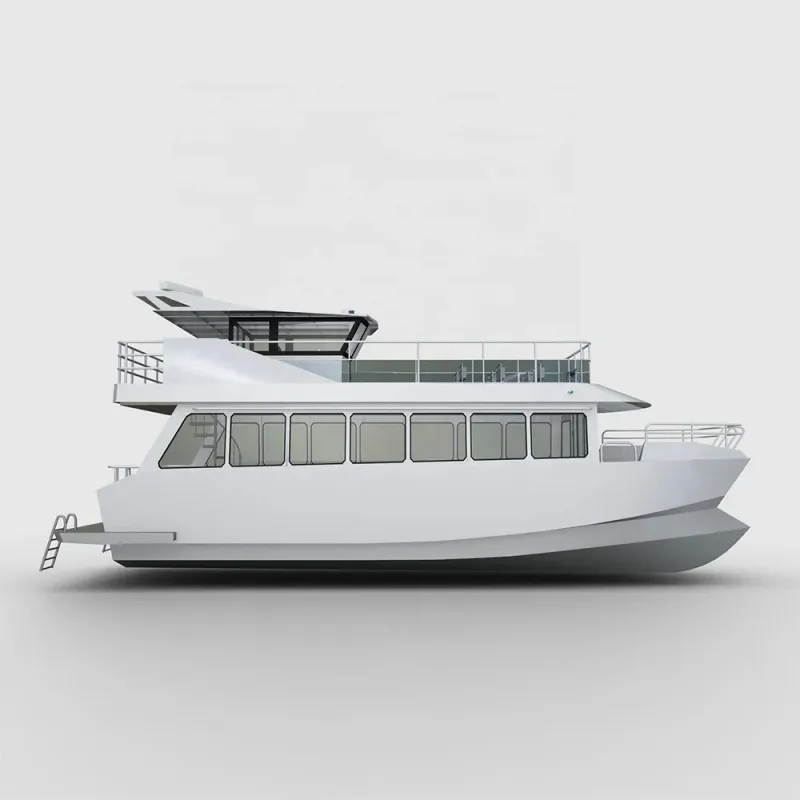
Catamaran: The usual choice for high-capacity commuter ferries, with better lateral stability, a wider beam that makes wheelchair access easier, and lower drag for better propulsion efficiency.
Material Evaluation
Construction material affects draft, maintenance, and propulsion requirements, so weigh its structural benefits against operating limits.
-
Aluminum: A light structure and shallow draft suit shallow waters. Aluminum is the main choice for fast ferries and electric propulsion.
-
Steel: Very durable for heavy commercial use and strong in ice or debris, but heavy, so it needs more power to reach the same speed.
-
Composite/FRP (Fiberglass Reinforced Plastic): Low hull maintenance and no corrosion, suitable for some tourism uses, but major structural damage can be hard to repair in many regions.
Powering the Commercial Passenger Boat: Propulsion and Regulations
Engine and propulsion choices must account for regulations, balancing speed against tightening environmental rules. A modern commercial passenger boat needs reliable, compliant power.
Traditional Diesel vs. Hybrid Solutions
Diesel is still common, but rules keep tightening. High-speed, long-distance routes may need EPA Tier 4 diesels or the local equivalent, with exhaust after-treatment and space for diesel exhaust fluid (DEF) tanks. Hybrid diesel systems suit routes that mix slow harbor running with fast open-water legs: the boat maneuvers quietly on battery near the dock, then switches to diesel for fast transit, keeping engines at efficient loads and cutting emissions in populated areas.
Fully Electric Battery Systems
Zero-emission ferries bring their own challenges, so weigh risks and benefits carefully before choosing battery power. Fully electric boats need predictable routes, since they cannot easily divert to a distant port, and they depend on high-power shore charging, so the boat is only as reliable as the local grid. Electric motors need far less mechanical maintenance than diesels, but battery banks are heavy, degrade over time, and must be replaced periodically.
Interior Layout, Accessibility, and Passenger Flow
Base the layout on capacity targets and passenger needs. A poor layout frustrates passengers and delays schedules, so every seat, aisle, and door should have a clear purpose.
Optimizing the Deck Plan
The deck plan directly affects turnaround time. Wide aisles prevent bottlenecks, and boarding gates at several points let passengers embark and disembark at the same time, shortening time at the dock. Balance indoor climate-controlled seating with outdoor decks according to the climate: tropical routes need strong air conditioning and shaded decks, while cold routes need good heating, heated decks against ice, and more indoor seating.
ADA and Accessibility Compliance
Accessibility is a legal requirement, not an option. Flush thresholds prevent trips and suit mobility devices, wheelchair tie-downs belong in good seating positions, and restrooms must meet local access codes. Build these in at the design stage: retrofitting wider doors or heavy ramps later shifts the center of gravity, requires new stability tests, and can seriously delay certification.
Navigating Regulatory Compliance and Build Risks
Boatbuilding carries strict legal and safety requirements. A boat that does not meet the rules cannot legally carry passengers.
Classification Societies and Flag States
Involve the regulators before any metal is cut. Classification societies such as ABS, DNV, CCS, or BV, and the local maritime authority, must approve the design drawings. Understand both intact and damage stability: intact stability keeps the boat upright in normal weather and with passengers moving around, while damage stability keeps it afloat if a compartment floods. Passenger boats face some of the strictest stability criteria in the industry.
Mitigating Shipyard Implementation Risks
Shipyard builds need close oversight. Allow for supply chain realities: specialized propulsion units and custom electronics can have long lead times, so order them well before construction starts. We recommend appointing an independent owner’s representative or marine surveyor to check weld quality, track milestones, make sure the yard follows the approved drawings, and protect your interests if disputes arise.
Shortlisting Builders for Your Custom Passenger Ferry Boat
Procurement needs a clear checklist, because you are entering a multi-year partnership, not just buying a product. The right builder for your custom passenger ferry boat decides the success of the project.
Use these evaluation criteria when vetting shipyards:
-
Portfolio match: Does the yard have proven boats in service? It should have experience with your use case and hull material.
-
Financial stability: Check bonding capacity, and make sure the yard accepts milestone payments rather than a large upfront deposit.
-
Post-delivery support: Review warranty terms carefully, and confirm full sea trials, crew training, and spare parts supply.
Follow these next actions to solicit accurate bids:
-
Define your exact route parameters, including speed, capacity, and wake restrictions.
-
Consult with a naval architect to draft a preliminary Statement of Requirements (SOR).
-
Issue a precise Request for Proposal (RFP) to a shortlist of qualified builders.
-
Compare the received bids based on technical compliance, not just the lowest initial build cost.
Conclusion
A successful build puts route conditions and regulatory compliance first. Focus on operating data rather than looks; whether you need a fast commuter boat or a slow sightseeing platform, the engineering basics are the same. Define your mission early, choose a hull and propulsion package that suits your boarding cycles and environmental rules, and never compromise on stability or accessibility.
Talk to a naval architect or experienced builder early to refine your Statement of Requirements. Good guidance at this stage brings accurate bids and helps avoid costly shipyard delays.
FAQ
Q: How much does a custom passenger ferry boat cost?
A: Costs vary widely with seat count, hull material, and propulsion. A small aluminum water taxi needs very different capital from a 300-passenger hybrid catamaran. Draft a Statement of Requirements first to get accurate shipyard quotes instead of relying on general figures.
Q: How long does it take to build a commercial passenger boat?
A: It depends on size and complexity. For aluminum passenger boats from 10.5m to 21m built to an established design, typical delivery is 60–90 days after deposit, depending on specification. Larger ferries with a new design and full class approval can take a year or more, and supply delays for specialized engines can extend this.
Q: Can an existing water taxi be converted into a fully electric passenger boat?
A: Conversions are very difficult. Adding heavy battery banks to an existing hull changes its center of gravity and stability. Purpose-built electric designs place batteries for the best balance and performance, so new builds are usually safer and more efficient.
Planning a passenger ferry project? Send us your route, capacity, and operating conditions, and our engineers will recommend a configuration and quotation.


