
1. Key Takeaways
-
Route Dictates Design: Sea state, wake restrictions, and trip length should set the baseline specification before you choose a hull form.
-
Catamarans vs. Monohulls: Catamarans offer better stability and efficiency at higher capacities, while monohulls stay cost-effective on shorter, lower-capacity routes.
-
Material Selection Matters: An aluminum passenger boat saves significantly over its life through fuel economy and corrosion resistance compared with steel or heavy fiberglass.
-
Layout Drives Profitability: Dock turnaround time and crew efficiency depend directly on deck layout and accessibility.
2. Evaluating Route Distance, Sea State, and Capacity Requirements
Start with a clear operating profile, because the body of water sets everything else. Water depth, fetch (the distance wind blows over open water), and wave period decide the boat you need: long fetch produces larger waves the boat must handle safely, and shallow water calls for a different propulsion system. For the decisions that come before and after the purchase, including safety, maintenance, and running costs, see our complete guide to passenger boats.
Plan capacity carefully to avoid running a near-empty boat. Over-specifying capacity means operating empty seats at a loss. Instead, compare peak-season and off-season demand; two smaller boats may give more flexibility in slow months and keep operating costs in line with actual demand.
Route distance shapes speed and comfort requirements. We look at two types of route:
-
Short-hop and River Crossings: These need quick acceleration, tight maneuverability, and fast docking; top speed matters less.
-
Coastal and Extended Routes: These need a sustained cruising speed, larger fuel capacity, and more passenger comfort, including good air conditioning and active stabilization.
Do not forget local infrastructure and environmental limits. Shallow draft restricts propeller choice, no-wake zones affect your schedule, and the boat’s deck height and fendering must suit your existing terminals.
3. Selecting the Right Hull Design: Monohull vs. Catamaran
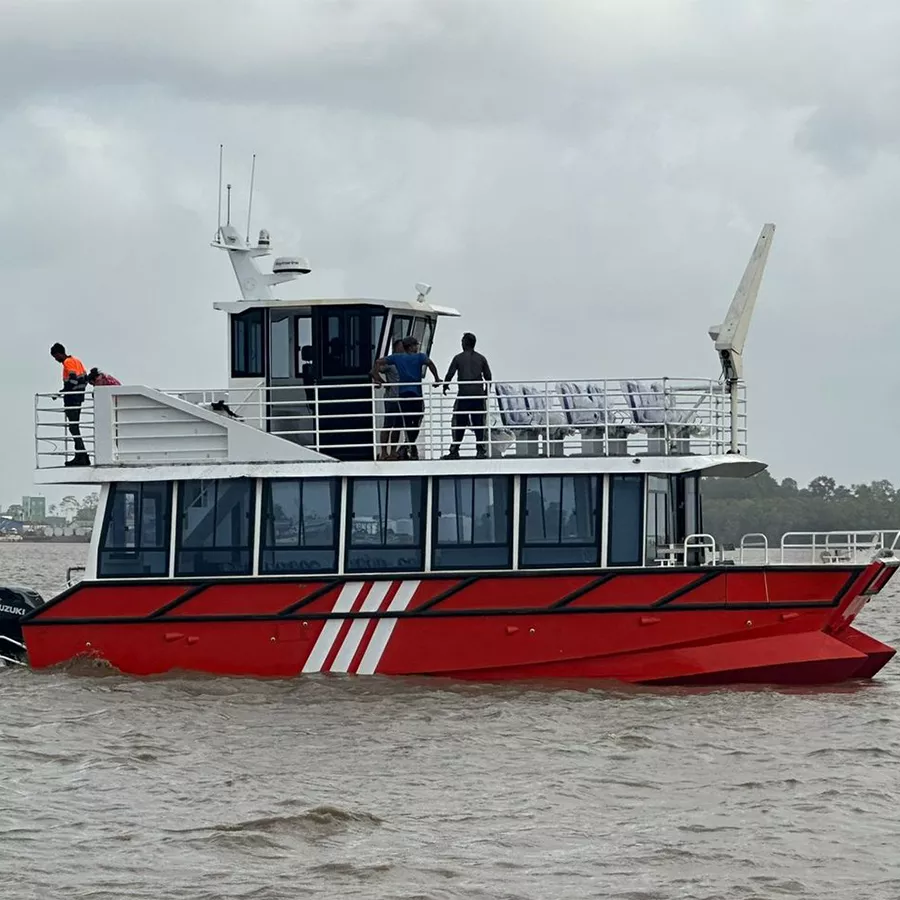
There are two main hull forms for commercial operators, monohull and multihull, and the choice needs care. A Catamaran Passenger Boat is now the most common choice in commercial ferry purchasing. Its wider beam allows more passengers without increasing draft.
Catamarans also make less wake, which matters on inland waterways: lower wake energy protects sensitive shorelines and moored boats. They also roll less, so passengers suffer less seasickness in choppy water.
Monohulls still make sense in some situations. They fit narrow berths, where older municipal docks may be too tight for a wide catamaran, and they handle steep, short-period seas well. They also cost less to build, because a single hull needs less material and labor.
Match the hull choice to water depth and propulsion. Shallow or debris-filled routes favor waterjets, which sit inside the hull and avoid striking logs or rocks. Deep-water routes usually use fixed-pitch propellers, which give good low-speed maneuvering and strong thrust when docking.
Hull Design Comparison
|
Feature |
Monohull |
Catamaran |
|---|---|---|
|
Passenger Density |
Moderate |
High |
|
Draft Requirements |
Generally deeper |
Shallower for equivalent capacity |
|
Wake Generation |
Higher |
Lower |
|
Roll Stability |
Standard |
Superior |
|
Initial Build Cost |
Lower |
Higher |
4. Hull Materials: Why the Aluminum Passenger Boat Is the Industry Standard
Hull material shapes the boat’s future performance, and the industry leans strongly toward marine-grade aluminum. Alloys such as 5083 and 5086 offer an excellent strength-to-weight ratio, and the lighter displacement of an Aluminum Passenger Boat brings direct operating benefits: smaller engines, lower daily fuel use, and large savings over a service life of decades.
Aluminum also simplifies life-cycle maintenance. It forms a protective oxide layer on contact with air, so it resists marine corrosion naturally, and there is no gelcoat to maintain as with fiberglass. Structural repairs are straightforward: the yard cuts out the damaged section and welds in new plate.
Compare the alternatives. Fiberglass needs molds, which raises the cost of custom designs, adds weight on large commercial boats, and can suffer osmotic blistering over time. Steel is very strong but heavy, rusts in salt water, and needs regular chipping, priming, and painting that takes the boat out of service.
Finally, consider end-of-life value. Aluminum keeps a high recycling value, so the material is still worth money when the boat retires, and used aluminum ferries are in demand on the secondary market.
5. Deck Layout and the Passenger Experience
Deck layout directly affects daily profit. Dock turnaround time sets your schedule, so boarding gates and aisle widths must allow fast passenger flow and minimal idle time at the dock.
Check your terminals first. Some allow docking on either side, while others force a one-sided boarding layout, and the deck plan must suit them.
Your passengers shape the interior. A commuter Passenger Boat needs durable, easy-to-clean seating and high-density layouts for peak hours, plus Wi-Fi and storage for bicycles and e-scooters.
Sightseeing boats have different priorities: panoramic windows, open upper decks for photos, a good PA system for guides, and onboard revenue such as snack kiosks and bars, which raise average spend per passenger.
Crew ergonomics are key to safe operation. The captain needs all-round visibility, including a clear view of the boarding gates from the helm. The engine room must have room for routine checks, and life rafts should be placed where they can be launched quickly in an emergency.
6. Regulatory Compliance and Certification
Classification and certification are essential. Buying an uncertified boat is a major risk, and retrofitting a non-compliant boat is usually very expensive. Rules depend on where you operate: in the United States, USCG Subchapter T or K; in Europe, the applicable EU directives; and internationally, the rules of IACS classification societies such as CCS, BV, or Lloyd’s Register.
Bring in compliance experts early, before construction starts. Submit the plans for approval first, so structural fire protection and stability calculations are reviewed in time. Approval takes time, but it secures legal operation.
Accessibility needs the same attention. Build accessibility requirements, such as ADA in the United States, into the initial design: wheelchair ramps, restroom doors of the required width, and accessible seating near the main entrances. Adding them after construction means costly structural changes; planning them early costs very little.
A common mistake is ignoring local emission rules. Some ports require IMO Tier III engines or hybrid-ready engine rooms, so check the environmental rules for your operating area to avoid fines and operating bans.
7. Procurement Next Steps: Shortlisting Shipyards
Choose your builder carefully. Check the shipyard’s financial stability first, since a failed yard can trap your deposit, and ask for proof that it can provide bonds. Review warranty terms closely and look for builders who guarantee their structural welding for several years.
Track record matters. Ask for references from current operators and check whether the yard has built your hull type before. A steel barge builder is not the right choice for a fast aluminum catamaran; experience with your material prevents costly fabrication errors.
Prepare a clear Statement of Requirements (SOR) to get an accurate quote. A good SOR includes:
-
Target Cruising Speed: Required speed when fully loaded.
-
Payload Capacity: Exact passenger numbers and luggage weight.
-
Route Conditions: Wave heights and docking infrastructure.
-
Preferred Propulsion: Jets or propellers, and preferred engine brands.
-
Classification Standard: The exact rules the boat must be built to.
Finally, choose between a fully custom design and a builder’s proven design. A custom project takes longer and more engineering hours but delivers exactly what you need. Adapting a proven hull saves time and engineering cost, and the builder can usually give a more reliable delivery date.
8. Conclusion
Buying the right passenger boat takes a disciplined approach. Put route conditions and life-cycle durability ahead of appearance. Knowing your operating environment leads to the right hull form, marine-grade aluminum supports long-term efficiency, and a well-planned deck layout improves daily revenue and crew safety.
Start by documenting your operating profile, including route distances, sea states, and capacity needs, before you approach naval architects or shipyards. A well-prepared buyer gets better pricing and avoids costly design mistakes.
Planning a passenger ferry project? Send us your route, capacity, and operating conditions, and our engineers will recommend a configuration and quotation.


