1. Key Takeaways
● Fast commuter ferries are usually built from aluminum, because a lighter hull saves fuel on frequent daily crossings.
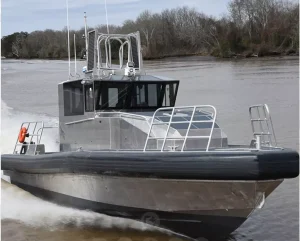
● Aluminum gives a better power-to-weight ratio, so a passenger ferry boat, like our 11.6m aluminum catamaran passenger boat, can reach higher speeds with smaller, more efficient engines.
● Steel remains the benchmark for impact resistance and suits ferry operations in ice or heavy debris.
● Marine-grade aluminum resists corrosion naturally, which cuts long-term maintenance compared with the constant painting a steel hull needs.
● Aluminum costs more to build, but total cost of ownership is often lower thanks to fuel savings and higher scrap value at the end of the boat’s life.
● Steel gives a heavier, steadier ride in rough seas, while aluminum allows a shallower draft for coastal and river routes.
● The right choice depends on the route: aluminum for fast transit, steel for heavy-duty, multi-purpose crossings.
2. Direct Material Comparison: Aluminum vs. Steel Passenger Ferry Boat
A boat’s basic physics start with the hull material. Aluminum weighs about one-third as much as steel for the same volume, and a typical aluminum hull structure weighs roughly half as much as an equivalent steel one. A lighter passenger ferry boat sits higher in the water, creates less drag, and moves through the waves more efficiently. Steel is far heavier but very strong. Hull material is one of several linked choices covered in our passenger boat guide.
Steel has higher ultimate tensile strength, but marine-grade aluminum alloys such as 5083 absorb impact energy well and are designed for marine structures. Aluminum also forms its own protective oxide layer, while steel needs constant attention: without good epoxy coatings and sacrificial anodes, a steel hull corrodes quickly in salt water.
Fabrication differs too. Steel is easy to weld, and welders are available in almost every port. Aluminum needs pulse-MIG or TIG welding by trained welders in a clean workshop to avoid contamination. Aluminum costs more to build, but with correct engineering its fatigue performance is excellent on high-frequency routes.
Note: Marine aluminum alloys do not burn, but they lose strength at lower temperatures than steel, so structural fire protection is needed to meet IMO and class rules.
Tip: Always confirm the alloy grade (for example, 5083-H116) to ensure good resistance to exfoliation corrosion in the hull.
3. Speed and Fuel Efficiency: The Aluminum Advantage
Speed is a key advantage of aluminum. A lighter hull has a much better power-to-weight ratio, so smaller engines reach the same speed as a steel boat, or the same horsepower gives clearly higher speed.
Fuel is where the numbers favor aluminum most. A lighter boat needs less energy to overcome hull resistance, and over thousands of nautical miles the savings add up. Lower fuel burn also means lower emissions per passenger-mile, which helps with tightening environmental rules, and engines that work less hard need overhauls less often.
Note: Aluminum hulls typically use around 20% less fuel than steel boats of the same capacity and speed, depending on design and route.
4. Durability and Maintenance Requirements for Steel Hulls
Steel is the toughest option in harsh conditions. If your ferry operates among floating ice or heavy timber debris, steel is the safer choice: it handles local impacts well and can be patched by almost any shipyard.
Its weakness is maintenance. Steel hulls need blasting and repainting every few years to control rust, plus a well-maintained cathodic protection system. Steel is cheaper to build because the raw material costs less, but these recurring costs eat into margins over time. Steel remains the usual choice for large ro-ro ferries, where weight matters less than structural toughness.
Tip: On steel boats, high-build glass-flake epoxy coatings can lengthen the intervals between dry-docking and repainting.
5. Stability and Passenger Comfort Dynamics
Passenger comfort is often overlooked in material debates. A heavier steel ferry has a longer roll period, which passengers often feel as steadier in choppy water, and it is pushed around less by waves than a light boat.
Aluminum, on the other hand, allows a much shallower draft, which is often decisive on routes with shallow river mouths or tide-restricted ports. A light superstructure also helps keep the center of gravity low. Steel naturally damps vibration better, but modern aluminum boats use floating floors and acoustic insulation to achieve similar comfort.
Note: Deep-V steel hulls are often preferred on offshore routes with high sea states, where seakeeping matters more than speed.
6. Financial Analysis: CAPEX vs. OPEX Over 20 Years
When buying a passenger ferry, look past the purchase price. An aluminum boat may cost around 20% more to build than a steel one, but operating costs tell a different story: with fuel savings and less painting, the aluminum boat often recovers the difference within five to seven years.
Resale value also favors aluminum, because the hull does not degrade like steel, and at the end of its life aluminum scrap is worth a significant share of the original material cost, while steel scrap is worth far less. Check insurance too: some underwriters prefer steel in high-risk areas, while others favor aluminum.
|
Metric |
Aluminum Hull |
Steel Hull |
|
Initial Cost (CAPEX) |
Higher |
Lower |
|
Fuel Efficiency |
Excellent |
Moderate |
|
Maintenance Need |
Low |
High |
|
Impact Resistance |
Good |
Superior |
|
End-of-Life Value |
High (Recyclable) |
Low |
Tip: Use a 20-year discounted cash flow (DCF) model to compare the true cost of both materials before signing a construction contract.
7. Operational Suitability: Matching Material to Route
The best material depends on the mission. For fast urban transit, aluminum is the clear choice: it supports quick turnarounds and the high cruising speeds water taxis need, and it is the standard for modern catamarans built for efficiency and shallow draft.
Steel suits heavy-duty, multi-purpose ferries. For heavy vehicles or Arctic conditions, steel’s weight and strength are an advantage. Check local repair capability as well: in a remote area with no aluminum welding equipment, steel may be more practical for emergency repairs.
Note: Many boats use a hybrid approach, with a steel hull for toughness and an aluminum superstructure to keep the center of gravity low.
8. Conclusion
The choice between aluminum and steel shapes how your fleet operates. Aluminum leads on speed, fuel economy, and low maintenance, which makes it the first choice for fast transit, while steel offers more ruggedness and lower build cost for heavy-duty work. Poseidon Boat builds aluminum passenger ferries designed for efficiency and long-term profitability. Every boat is built to CCS standards and tested before delivery, so your investment delivers the best return on the water.
Planning a passenger ferry project? Send us your route, capacity, and operating conditions, and our engineers will recommend a configuration and quotation.