-
Occupancy Benchmarks: A steady 70–80% occupancy is the best sign of the right boat size; buying for 100% peak-season capacity erodes annual margins.
-
Non-Linear Scaling Costs: Crew requirements, regulatory compliance (for example, USCG Subchapter T or local equivalents), and insurance rise in steps, not smoothly, as capacity increases.
-
Infrastructure Constraints: Dock space, draft limits, and turnaround times should set the boat’s physical size before you decide passenger count.
-
Speed vs. Efficiency: High-speed requirements (for example, 35 knots and above) change hull design, fuel capacity (often over 1,000 liters), and engine specification, especially at 60 passengers.
Success Criteria: Framing Your Fleet Capacity Problem
Analyzing Route Demand and the 70–80% Rule
Compare off-peak demand with peak-season spikes carefully, and do not buy a boat for the busiest weekend of the year. Track daily passenger counts over a full season, comparing an average Tuesday with a holiday weekend, and include weather-affected days and shoulder seasons; historical ticket data gives the most accurate baseline. Targeting 70–80% average occupancy gives the best operating efficiency, because empty seats still cost fuel and crew attention without earning revenue. A boat that runs consistently at 80% keeps overhead manageable in slower months, and a mostly full boat also feels lively, while an empty cabin feels cold. Plan capacity around sustainable daily averages. For the decisions that follow once capacity is set, see our complete guide to passenger boats.
To project route demand accurately:
-
Collect three years of ticketing data to identify true seasonal peaks and lows.
-
Compare passenger counts with weather records to account for rained-out days and small craft advisories.
-
Check local hotel occupancy in the shoulder seasons to gauge off-peak potential.
-
Calculate the fuel and crew cost of running an empty boat on your longest route.
-
Establish a break-even passenger count for every scheduled departure time.
Regulatory Thresholds and Crewing Mandates
Regulators classify boats by passenger count, tonnage, and length, and crossing certain passenger thresholds brings strict new requirements. Going from 49 to 50 passengers, for example, can change a great deal: a higher-grade captain license, more deckhands, and stricter crew ratios that set your daily labor cost. Larger boats also need dedicated crew space, more safety stations, life rafts for the full passenger count, more complex fire suppression, and more rigorous stability testing. Map the local rules before fixing capacity, since ignoring these thresholds leads to major budget overruns, and talk to local marine surveyors early about how rules are applied in your region.
|
Passenger Capacity |
Typical License (US Example) |
Minimum Deckhands |
Safety Equipment Scaling |
|---|---|---|---|
|
Up to 20 Passengers |
OUPV or 25-Ton Master |
0–1 (route dependent) |
Standard Type I PFDs, basic flares |
|
21 to 40 Passengers |
50-Ton Master |
1–2 |
Inflatable buoyant apparatus (IBA), fixed fire suppression |
|
41 to 60 Passengers |
100-Ton Master |
2–3+ |
High-capacity life rafts, EPIRB, advanced stability letters |
Infrastructure and Route Constraints
Length, beam, and draft decide whether a boat suits the route. Shallow water needs minimal draft, narrow channels limit beam, and low bridges and tides add their own limits, so measure the route before choosing a boat. Commercial berths come in standard sizes, and larger boats pay premium fees; a beam over 3.5m often needs an end-tie berth, which limits your mooring options. Shore power needs also grow with boat size. Confirm infrastructure limits before deciding passenger count, because upgrading docks can cost more than the boat.
Check the turning basin at your main port: a long monohull may need a bow thruster to leave the fuel dock against a running tide, while a catamaran needs a double-width berth. Measure piling heights at the highest tides, since rub rails slipping over pilings can cause serious hull damage. Check the shore power supply too: air-conditioning a cabin for 60 people may need a 50 A or 100 A connection, and with only 30 A at the berth you will burn diesel running the generator at the dock.
Evaluating 20 to 60 Passenger Boats by Size Category
The 20 Passenger Boat: Agility and Premium Charters
A 20 passenger boat is all about agility and access. It suits private charters, eco-tours, VIP transfers, and dive operations. The advantages are immediate: fewer crew, access to shallow or restricted waters, manageable capital cost, and easier off-season storage, with many boats in this class around 9–10m long. The limits are a lower revenue ceiling per trip and greater sensitivity to weather, since rough seas keep small boats in port. Premium ticket prices are needed for good margins; high-volume, low-price models rarely work at this size.
Operators often choose twin outboards at this size. They give excellent maneuverability, can be trimmed up over shallow reefs and sandbars, and a failed engine can be replaced in an afternoon to keep the route running. Perimeter seating maximizes open deck space, which suits dive tanks and sightseeing guests who move from side to side for photos.
The 30 Passenger Boat: The Mid-Tier Workhorse
The 30 passenger boat is the mid-size workhorse for boutique dinner cruises, specialist sightseeing, and small corporate events. It combines an intimate experience with better margins than smaller boats and offers flexible layouts, from commuter seating for transit to lounge seating for sunset cruises. This size often triggers stricter compliance without the revenue of larger boats, so operating costs must be tightly controlled and marketing should target group bookings for baseline revenue. This size is a mainstay of coastal tourism worldwide.
At this size, onboard systems become more complex. You need a proper marine toilet with a holding tank for a full day, plus fresh water for sinks and deck washdown. Hulls usually move toward heavier displacement or semi-displacement forms to handle 30 adults moving around the deck, and inboard diesels with straight shafts or V-drives become popular for their torque and long, reliable service.
The 40 Passenger Boat: Scaling for Volume
Scaling up calls for a 40 passenger boat, used for scheduled ferry routes, larger coastal tours, and event charters. The advantage is volume: more revenue per trip, lower fuel cost per passenger, room for luggage storage, and several toilets. The challenge is filling the seats, which takes marketing and established tourist traffic to keep off-peak occupancy profitable. Plan the space carefully to avoid a cramped feel at upscale events, and expect longer boarding times that need good crowd management and crew training in passenger flow and evacuation.
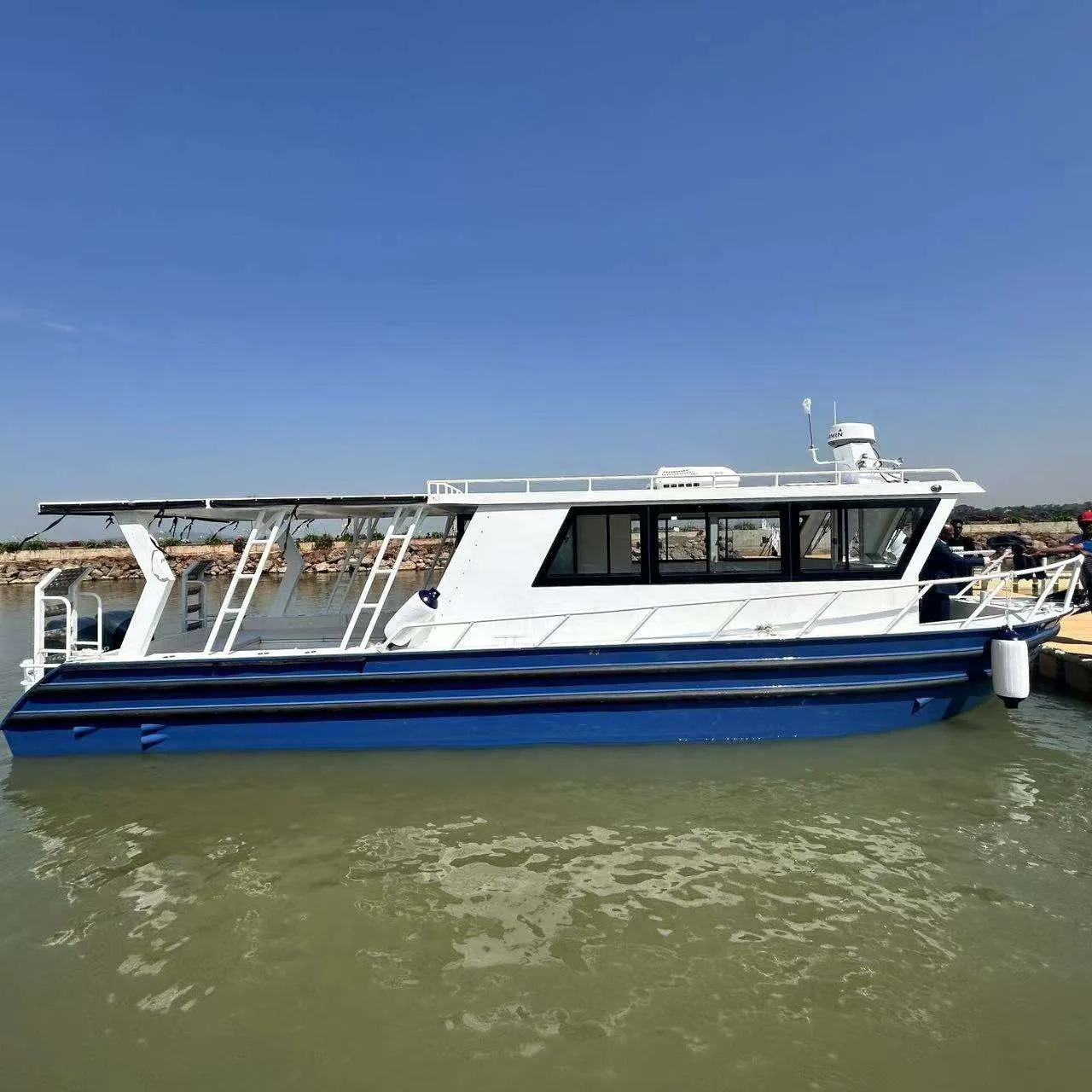
Catamarans dominate this size. Their wide beam keeps the boat level when all 40 passengers move to one side to see marine life, reducing seasickness, and allows separate zones such as a climate-controlled cabin and an open upper deck. With 40 people on board, a dedicated deckhand should look after passenger safety and comfort so the captain can focus on navigation.
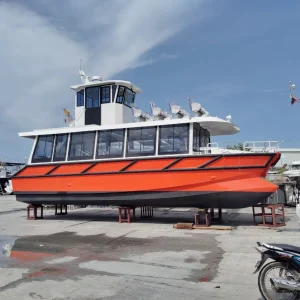
The 60 Passenger Boat: High-Capacity and High-Speed Operations
High-volume routes call for a 60 passenger boat, used for commuter ferries, mass-market tourism, and fast island transit. It offers the most tickets per run and suits busy, established routes. The drawbacks are high capital cost, heavy fuel burn, and strict safety and crewing rules. High speeds with a full load need specialized hull designs and large fuel tanks, often 1,000–1,200 liters, which reduce payload and margins, and engine maintenance becomes intensive, so keep critical spare parts in stock to avoid downtime.
At 60 passengers you are running a substantial commercial boat. Propulsion is often four high-power outboards or twin inboard diesels with waterjets. Waterjets have no exposed propellers, a real safety advantage near swimmers or in debris-filled rivers, but their impellers and wear rings need precise maintenance. Electrical demand is high, so you need heavy-duty generators for commercial air conditioning, radar, and PA systems.
Core Evaluation Dimensions: Features to Operational Outcomes
Hull Design, Weight, and Propulsion Systems
Hull design sets the operating envelope. Monohulls cut through rough water and handle head seas predictably, while catamarans offer more stability, more usable deck space, and smaller wakes in speed-restricted zones. Propulsion depends on speed: outboards are easy to service and replace, inboard diesels give long life and torque for heavy loads, and waterjets suit shallow, debris-filled water. Weight distribution matters in every design, because heavy inboards need careful balancing and moving passengers shift the center of gravity, so naval architects must check intact stability at full load.
Consider the local service network when choosing propulsion. An unusual engine brand is no use if the nearest certified mechanic is far away, so choose brands with strong commercial support at your port.
|
Design Feature |
Monohull Platform |
Catamaran Platform |
|---|---|---|
|
Deck Space |
Restricted by forward beam taper |
Expansive rectangular footprint |
|
Stability |
Prone to rolling in heavy beam seas |
Highly stable, minimal roll platform |
|
Draft Profile |
Generally deeper draft required |
Often shallower draft capabilities |
|
Wake Generation |
Larger displacement wake profile |
Minimal wake, ideal for rivers |
Passenger Comfort and Turnaround Efficiency
Passenger comfort drives repeat business and good reviews. The layout depends on trip length and the passengers you serve: generous charter-style spacing for upscale trips, high-density seating for short ferry runs. Enclosed cabins need climate control in extreme weather, and the number of toilets must match passenger numbers and trip length. Turnaround efficiency directly affects daily revenue, so plan the deck for safe, fast boarding and disembarking, with wide aisles, several gates, non-skid decks for wet boarding, and clear signage. Faster turnarounds allow extra daily runs, which add directly to profit.
To shorten turnaround times at the dock:
-
Fit boarding doors on both sides to suit different dock layouts.
-
Use aisles wide enough for two people to pass comfortably.
-
Place luggage racks next to the boarding doors so passengers do not drag bags through the cabin.
-
Use heavy-duty, oversized cleats so deckhands can secure lines in seconds.
-
Give the helm a clear view of the boarding gates so the captain can watch passenger flow.
Fleet Scalability and Redundancy
Fleet scalability needs long-term thinking. Two 30-passenger boats give redundancy and flexible scheduling: if one needs maintenance the route stays open, and off-peak you can run one boat to save fuel. A single 60-passenger boat lowers total crew costs, with one captain and one set of deckhands, but one breakdown stops the entire operation until repairs are done. Two boats also allow staggered maintenance and testing new routes without committing large capacity, so weigh your risk tolerance before choosing one large hull.
Identical sister boats bring big advantages: one type of oil filter, impeller, and spare propeller in stock, and crews who can switch between boats without learning a new helm or electrical panel. Standardization greatly reduces training time and maintenance errors.
Financial Trade-Offs and Operational Economics
Capital Expenditure (CapEx) vs. Operating Expenses (OpEx)
Compare the purchase price with ongoing costs; the build cost is only the beginning, and operating costs decide long-term survival. Financing terms vary with boat type, outfitting level, and intended use, and lenders see a high-capacity ferry differently from a boutique charter boat. Project operating costs over at least five years, because fuel, crew, and dockage often exceed the build cost. Routine maintenance takes a predictable share of revenue, but unplanned breakdowns hurt cash flow, so keep a contingency fund and track every consumable, from engine oil to cleaning supplies.
In the build contract, tie payment milestones to physical progress and never pay ahead of visible work. An independent marine surveyor should inspect the boat at each milestone before funds are released.
Fuel Efficiency vs. Speed Requirements
Speed costs money, and fuel consumption rises steeply with speed. A fully loaded 60-passenger boat at 30 knots or more needs a lot of power and burns fuel quickly. Calculate fuel cost per passenger-mile by dividing hourly fuel burn by cruising speed and then by average passenger load. Dropping speed by a few knots can save a great deal each month, and passengers rarely notice a small speed reduction but always notice higher fares. Optimize cruising rpm and fit fuel flow meters to monitor consumption in real time.
Hull fouling hurts fuel efficiency. Even a thin layer of marine growth adds drag, so you burn more fuel to hold the same speed. Schedule regular hull cleaning; a diver costs far less than the extra fuel burned pushing a dirty hull.
Insurance, Maintenance, and Depreciation
Commercial marine insurance varies widely with passenger count, route risk, boat age, and replacement value. Larger commercial boats need regular dry-docking, with bottom painting, running gear inspections, and anode replacement to prevent galvanic corrosion. Depreciation also matters: aluminum hulls generally hold their value better than fiberglass because they withstand impact damage in hard commercial use. Keep detailed maintenance records, since buyers of used commercial boats expect a full service history.
Do not skimp on preventive maintenance. Check oil, raw-water strainers, and bilge pumps daily, because a failed float switch can sink an expensive boat at the dock. Give the crew clear daily, weekly, and monthly checklists and hold them accountable.
Implementation Risks and Mitigation Strategies
Navigating Maritime Compliance and Certifications
Failed stability tests delay launch, exceeding weight limits forces redesigns, and missing safety equipment keeps the boat at the dock. Reduce these risks early: involve a qualified naval architect at the concept stage, and choose a builder with a proven record who understands the local regulators. Pre-construction compliance reviews save months, and surveyors should visit at set build milestones rather than at the end. Document structural welds and material specifications; transparency with regulators speeds up certification.
Be very careful about modifying an existing boat to carry more passengers. Adding a deck or lengthening the hull changes the center of gravity and requires a new inclining experiment, which is expensive and often shows that the boat cannot safely carry the extra load.
Crew Hiring, Training, and Retention
Shortages of licensed captains and trained deckhands limit operating days in many regions, and the problem grows as crew ratios rise. Offer competitive pay and predictable schedules, partner with local maritime schools, and help deckhands work toward their captain’s license. Retention costs less than constant recruiting: provide good uniforms and crew rest areas, and respect mandatory rest periods. A loyal crew looks after the boat, while high turnover leads to equipment abuse and poor service.
Run a rigorous safety training program, with monthly man-overboard, fire, and abandon-ship drills, so the crew reacts to emergencies by reflex and stays calm and in control when passengers panic.
Managing Off-Season Downtime
Seasonal operators face long cash flow gaps, and storing and winterizing larger boats is costly. Look for off-season contracts such as crew transfers or light freight, and schedule major refits during layup. Protect the boat with proper cover and storage, flush raw-water systems with antifreeze, remove soft furnishings to prevent mold, maintain the batteries, and treat fuel tanks against bacterial growth. A disciplined layup routine prevents costly surprises when you recommission in spring.
Use the off-season to refresh marketing and ticketing systems, update your website, negotiate contracts with tour operators, and pre-sell discounted tickets to bring in winter cash flow.
Conclusion
To get the most from your investment:
-
Analyze the route to find your true average passenger load before choosing a hull size.
-
Check crewing and safety requirements for your target capacity with the local maritime authority.
-
Measure dock spaces and route depths to make sure the boat fits your infrastructure.
-
Calculate fuel cost per passenger-mile at realistic cruising speeds, not theoretical top speed.
-
Get commercial marine insurance quotes early to project annual operating costs accurately.
FAQ
Q: What defines the regulatory threshold for passenger boats?
A: Regulators classify boats by passenger count, gross tonnage, and length. Crossing certain numbers, such as going from 49 to 50 passengers, brings stricter rules on captain licensing, crew ratios, and safety equipment.
Q: How does passenger capacity affect crew requirements?
A: More passengers mean more crew under maritime rules. Larger boats need captains with higher-tonnage licenses and more trained deckhands for crowd control and emergency evacuation.
Q: Is a catamaran better than a monohull for 40 passengers?
A: Usually, yes. A catamaran gives a wider, more stable platform and more deck space for 40 passengers, rolls less in beam seas, and makes a smaller wake, although a monohull may handle heavy head seas better.
Q: What is the average fuel consumption for a 60-passenger high-speed ferry?
A: It varies widely with engines and hull design, but driving a fully loaded 60-passenger boat at 30 knots or more takes a lot of power, often hundreds of liters per hour, with fuel tanks of over 1,000 liters.
Q: Can I use a 20-passenger boat for offshore routes?
A: It depends on hull design, stability approval, and local rules. Twenty-passenger boats are agile but more sensitive to weather and rough seas, so they are usually better suited to protected coastal or inland waters.
Q: How do I calculate optimal occupancy rates?
A: Track daily passenger counts across a full season, including off-peak and shoulder months, and choose a boat size that keeps average occupancy at a steady 70–80%, rather than sizing for holiday peaks.
Related reading
- 30 vs 40 Passenger Ferry Boat: How to Choose the Right Capacity: what 10 extra seats change in rules, crew, and cost
- 50–105 Seat Passenger Ferry Boat Buying Guide for Operators: specs, compliance, and procurement for larger ferries
- What Capacity Passenger Boat Is Best for Tourism Services?: capacity tiers for sightseeing and tour operations
Planning a passenger boat project? Send us your route, capacity, and operating conditions, and our engineers will recommend a configuration and quotation.