Key Takeaways
-
Uptime dictates profitability: A structured maintenance program turns costly emergency repairs into predictable operating costs.
-
Material matters: Aluminum passenger boat hulls need specific galvanic corrosion control, different from composite boats.
-
Compliance is non-negotiable: Maintenance records are essential for safety audits and for limiting liability.
-
Scalability requires software: Moving from paper checklists to digital tracking is what lets a fleet grow without losing control.
The Economics of Uptime in Commercial Passenger Boat Operations
Uptime is the lifeblood of a ferry service. A cancelled sailing means refunds, unhappy commuters, and sometimes paying for replacement road transport, while planned maintenance costs little in comparison: a scheduled filter change is cheap next to an emergency tow. An engine failure mid-channel can also cause passenger panic and media attention. Preventive care keeps you in control of your schedule. Maintenance planning starts at the specification stage, as our passenger boat guide explains.
Measure your maintenance program against three criteria:
-
Dispatch Reliability Rate: How often boats leave on time. High reliability builds customer loyalty and helps win transport contracts.
-
Mean Time Between Failures (MTBF): The average running hours between unscheduled repairs. A rising MTBF shows your preventive schedule is working.
-
Audit Readiness: Maritime authorities expect complete records at all times, so your paperwork must be ready for unannounced inspections.
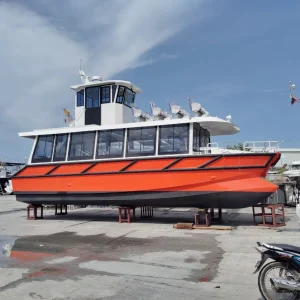
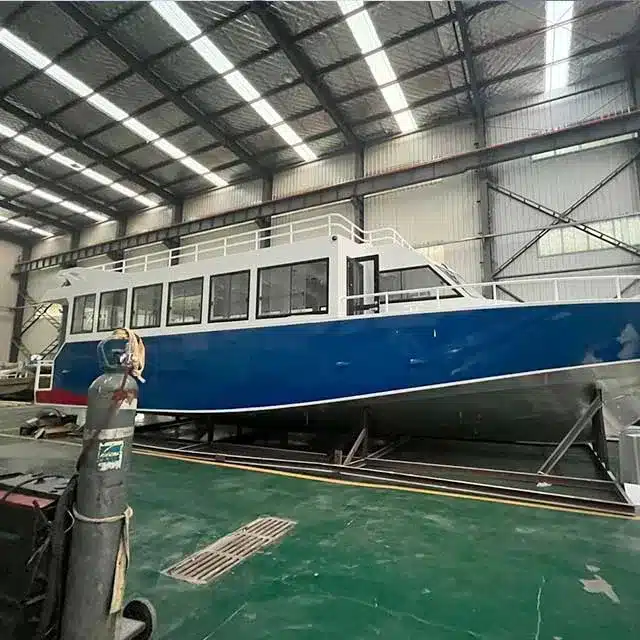
Running a commercial passenger boat such as our 15m aluminum monohull passenger boat every day brings particular stresses. Constant boarding puts cyclic loads on the structure, short crossings mean engines often shut down before reaching full operating temperature, and air conditioning for crowded cabins puts heavy demand on the electrical system.
Best Practices and Common Mistakes
-
Best Practice: Tie the maintenance plan to engine hours rather than calendar dates.
-
Common Mistake: Putting off investigation of minor vibration to save time, which can end in serious shaft or gearbox failure.
Daily and Weekly SOPs for Passenger Ferry Operation
Reliable passenger ferry operation depends on clear standard operating procedures (SOPs). Daily checks catch small faults before they turn into cancelled sailings.
Pre-departure checks are the first line of defense. Crews should check engine oil, coolant, and transmission fluid before starting; milky oil is an immediate sign of water ingress. Clean the raw-water strainers so heat exchangers get full cooling flow, and look over the hull for new docking damage before it becomes a structural issue. Check propulsion and steering linkages for responsive control when docking, and verify safety equipment every day: life jackets, fire detection sensors, and communication systems.
Weekly and monthly checks cover the less visible systems. In peak season, air conditioning needs weekly attention: replace filters and clean ducts to prevent mold and keep cabin air fresh. Test bilge pumps manually, because sludge can jam float switches and disable automatic pumping. Load-test battery banks weekly and clean the terminals to prevent voltage drops on cold starts.
Best Practices and Common Mistakes
-
Best Practice: Laminate daily checklists and have crews mark them with dry-erase pens for clear accountability.
-
Common Mistake: Ticking checklists without actually checking bilge levels, which can lead to a flooded engine room.
Aluminum Passenger Boat Maintenance vs. Composite Hulls
Proper aluminum passenger boat maintenance differs greatly from fiberglass boat maintenance, and galvanic corrosion control comes first. Dissimilar metals in salt water act like a battery and strip metal from the hull unless you intervene. Sacrificial anodes, zinc or aluminum blocks bolted to the hull, corrode in place of the hull. Stray currents in busy marinas speed this up, and faulty shore power nearby can badly damage a marine aluminum passenger boat hull within weeks.
The wrong cleaning products damage the protective oxide layer, and strongly alkaline soaps can cause deep pitting on bare aluminum, so use pH-neutral cleaners made for marine aluminum. Bottom paint needs equal care: copper-based antifouling causes severe galvanic corrosion on aluminum, so specify copper-free products such as modern biocide or silicone foul-release coatings.
Repeated wave impact causes metal fatigue over thousands of hours. Technicians should check welds regularly for hairline cracks, often using dye penetrant testing at high-stress joints near engine mounts, so small cracks are caught before they affect watertight integrity.
Comparison: Aluminum vs. Composite Maintenance Needs
|
Maintenance Area |
Aluminum Hulls |
Composite (Fiberglass) Hulls |
|---|---|---|
|
Antifouling Paint |
Copper-free only (thiocyanate or silicone) |
Copper-based paints commonly accepted |
|
Corrosion Focus |
Galvanic isolation, stray current mitigation |
Osmosis prevention, gelcoat blistering |
|
Structural Checks |
Weld fatigue, stress cracking at joints |
Fiberglass delamination, moisture intrusion |
|
Cleaning Agents |
Strictly neutral pH soaps |
Tolerates much wider pH ranges |
Marine Diesel Engine and Propulsion Systems Optimization
Ferry engines work grueling daily schedules, and stop-and-go routes are especially hard on them. Engines heat up under heavy load, then cool quickly while passengers disembark, and this constant thermal cycling stresses head gaskets and turbochargers. Manage the duty cycle by enforcing idle cool-down periods before shutdown.
Fuel system integrity keeps the fleet running. Commercial fleets use thousands of liters a week, which raises the risk of water and microbial contamination; condensation in large tanks breeds bacteria and collects water at the bottom. High-pressure injectors can be damaged by tiny amounts of water, so use fuel polishing systems and high-capacity water separators to stop contaminants before they reach the high-pressure pump.
Good propulsion maintenance lowers daily fuel costs. Correct trim reduces drag so the boat runs cleanly instead of pushing a heavy bow wave, and clean propellers slip less. Even light barnacle growth or a slightly bent blade makes the engine work harder, raising exhaust temperatures and wasting fuel.
Best Practices and Common Mistakes
-
Best Practice: Fit secondary centrifugal fuel filters and check the clear bowls daily for water.
-
Common Mistake: Shutting down hot engines immediately after docking, which bakes oil onto turbocharger bearings.
Safety Compliance, Standards, and Audit-Ready Tracking
Local maritime rules govern every part of operation. Authorities such as the USCG or MCA enforce commercial standards strictly, and international standards such as ASTM set benchmarks for safety and material performance. Strict compliance protects passengers and your operating license.
Paper logbooks create real liability risk, because smudged entries, skipped pages, and lost binders can sink you in an audit. Upgrading your passenger ferry boat maintenance records means going digital. A computerized maintenance management system (CMMS) lets crews log completed tasks on rugged tablets with automatic timestamps and alerts management when, for example, a bilge pump is due for replacement.
Documented maintenance protects operators. After an incident, investigators immediately ask for proof of upkeep, and digital logs show your due diligence at once, which speeds up insurance claims and helps defend against negligence claims by proving you followed the manufacturers’ guidelines.
Best Practices and Common Mistakes
-
Best Practice: Link the CMMS to your parts store so spare parts are ordered automatically before critical components fail.
-
Common Mistake: Treating safety drills as paperwork instead of logging real tests of suppression systems.
Evaluating Maintenance Strategies: In-House vs. Outsourced Yard Services
Not everything can be fixed at the dock, and who does which job shapes fleet reliability, so you need a clear way to divide the work.
Deckhands and onboard engineers can handle daily checklists, minor servicing, fluid top-ups, and visual inspections, which makes good use of the crew and keeps costs low.
Major overhauls belong in a certified shipyard. Annual dry-docking needs heavy lifting equipment, and engine rebuilds, major electrical work, and hull blasting need specialist tools that cannot be replicated at the dock.
When shortlisting maintenance yards, assess them on three points:
-
Commercial Ferry Experience: The yard should have real experience with commercial passenger ferries; work on recreational yachts does not translate to the demands of commercial service.
-
Guaranteed Turnaround Times: Commercial operators work on tight margins, so ask for guaranteed dry-dock timelines with penalty clauses for late redelivery.
-
Industry Certifications: Check that the yard holds current certification for structural aluminum welding and employs factory-trained technicians for your diesel engines.
Best Practices and Common Mistakes
-
Best Practice: Book dry-dock slots at least six months ahead to secure the best yard rates.
-
Common Mistake: Choosing a yard on hourly rate alone and ignoring hidden lay-day fees and slow turnaround.
Conclusion
Good maintenance is a continuous operating strategy, not a periodic chore. It combines strict daily procedures with material-specific knowledge, and careful compliance records protect the business from liability. Preventive care turns unpredictable breakdowns into planned tasks and protects your reputation on the water.
Next steps:
-
Audit your current maintenance logs for gaps and compliance risks.
-
Evaluate marine CMMS software to digitize daily checklists and compliance tracking.
-
Look at partnering with a specialist commercial shipyard well before your next dry-docking.
-
Check the hull’s sacrificial anodes this week to confirm galvanic protection is still effective.
FAQ
Q: How often does a commercial marine aluminum passenger boat need new anodes?
A: Typically every 6–12 months, depending on water salinity, stray current in the marina, and operating hours. Inspect them regularly to make sure protection stays effective.
Q: What is the ROI of implementing digital maintenance tracking software?
A: It greatly reduces paperwork and makes sure parts are ordered well before critical failures. Digital records also help avoid fines for missing or incomplete documentation during unannounced audits.
Q: Can our crew handle daily commercial passenger boat maintenance, or do we need a dedicated engineer?
A: Deck crew can handle daily visual checks and fluid checklists, but regulators often require certified marine engineers for engine, electrical, and structural maintenance, depending on the boat’s size and maximum passenger capacity.
Planning a passenger ferry project? Send us your route, capacity, and operating conditions, and our engineers will recommend a configuration and quotation.