
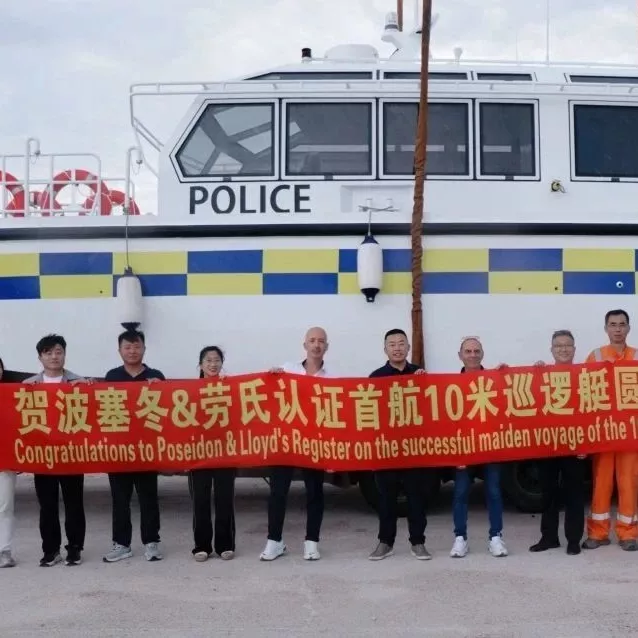
1. Mission Embodied in Ceremony: Launch of the Sea Trial
Designed and built by Shandong Poseidon Marine Technology Co., Ltd. and certified by Lloyd’s Register throughout, this patrol boat brings Chinese aluminum boatbuilding to a global humanitarian mission.
It is the first of four boats ordered for Pacific Island nations including Kiribati and Nauru. The project is a classic “small boat, big mission” challenge: high performance, durability, safety, and environmental responsibility in a compact 10m hull.
The trial began with a launch ceremony at the dock, attended by United Nations project delegates, Lloyd’s Register certification engineers, and Poseidon’s technical team. Unveiling the silver hull marked both a technical milestone and a commitment to international cooperation and humanitarian service.
A banner at the ceremony read: “The Lloyd’s Register Certification Project of Poseidon Boat.” The mood was one of pride and anticipation as the project moved from drawings to real service.
2. Real-Time Validation: Speed, Stability, and Survivability at Sea
After the ceremony, the boat headed to the sea trial area for performance testing. With twin 300 HP outboards, it reached its design top speed of 30 knots and held 25 knots for 30 consecutive minutes in simulated rough-sea conditions, showing good stability, reliable propulsion, and an efficient hull.
Onboard systems were also tested:
Rescue communication systems stayed stable during high-speed maneuvers.
The marine radar kept a continuous, clear signal, confirming it is suitable for round-the-clock humanitarian operations in bad weather.
Structural checks confirmed the corrosion resistance and light weight of the aluminum alloy hull.
Lloyd’s Register field engineers recorded and analyzed data throughout the trial. Their preliminary results showed that the patrol boat met and exceeded international maritime safety standards, especially in structural design, corrosion resistance, and energy efficiency.
3. A Client’s Gratitude: From Design to Life-Saving Deployment
Representatives of the United Nations spoke at the ceremony. One senior delegate said:
“Thanks to Poseidon Boat. Thank you to Lloyd’s. It’s an honor to be here in China and to witness this very important milestone for us. The progress of this project has been a great development for the United Nations and for the Government of Japan. I am confident that our future collaborations will be fruitful for all parties. Once again, I thank Lloyd’s for their patience and Poseidon for their dedication. A big thank you to everybody involved in this project.”
The remarks recognized the engineering behind the project and showed how Chinese boatbuilders can deliver maritime solutions built to international standards.
4. Looking Ahead: Building Momentum for the Future
With the first sea trial complete, Poseidon Boat and its partners are ready to build more boats for wider use. For coastal surveillance, humanitarian logistics, or environmental response, these 10m patrol boats offer a proven, export-ready design. For how agencies plan and specify a patrol boat, see our patrol boat guide.
The project also shows how compact, well-engineered boats can meet complex international needs. As the Lloyd’s Register Qingdao Director said at the start of construction earlier this year:
“These four boats not only carry technological innovation but also the weight of shared human destiny. From material certification to operational reliability, every boat is a floating embodiment of our commitment to safety, efficiency, and sustainability.”
5. Conclusion: Sailing Toward Shared Purpose
As the first patrol boat cuts across the sea off Qingdao, the trial marks more than a technical success. It reflects China’s growing maritime capability, partnerships built on trust and performance, and a world where small boats can carry great missions of peace, resilience, and solidarity.
Cooperation is under way, and these patrol boats are leading the way.
The project is about more than delivering boats. It shows what technical skill and shared global responsibility can achieve together. The remaining three patrol boats are scheduled for sea trials and delivery by the end of August 2025.
Each boat will help island nations, some of the most vulnerable to climate change and natural disasters, run maritime patrols, deliver emergency aid, and protect marine resources more effectively.


