1. Key Takeaways
-
Start with the heaviest load you need to move in one trip, then add a margin. Payload sets the size of the boat.
-
Draft and beach conditions decide where you can land; most of our landing craft draw 0.31–0.55m.
-
A clear main deck and a ramp sized to your heaviest vehicle matter more than top speed.
-
Aluminum hulls are light, resist corrosion, and can be repaired by welding, which suits hard daily beaching.
-
Plan engines, fuel capacity, and maintenance access around your real route, not a brochure figure.
2. What a Landing Craft Does: Jobs and Formats
Landing craft carry vehicles, machinery, building materials, and supplies to places a normal cargo boat cannot reach: islands without ports, river banks, construction sites on the shore, and remote coastlines. The bow ramp turns any suitable beach into a loading point, so the boat can deliver straight to where the cargo is needed.
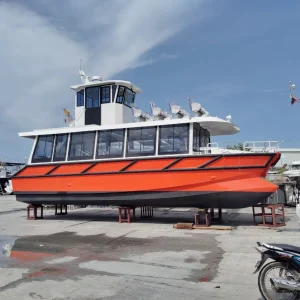
Smaller landing craft work as supply and utility boats, moving a few tons of goods, motorcycles, or light equipment on short runs. Larger ones carry trucks, excavators, and heavy loads over longer distances. Some are fitted out for people as well: the 21m aluminum landing craft passenger boat lands up to 100 passengers on beaches without piers, as covered in our passenger boat guide.
Our range of aluminum landing craft runs from 5.8m to 21m, with payloads from 0.6 to 30 tons.
3. Start with the Cargo and the Route
Write down what the boat must carry on a typical trip and on the heaviest trip: the vehicles or machinery, their weight and size, and whether they roll on or are lifted on. Add how far the boat runs, how many trips it makes each day, and where it loads and unloads. These figures decide deck length, ramp width, payload, and engine power more than any other factor.
Then look at the water and the landing sites. Sheltered rivers and bays allow a simpler, lighter boat, while exposed coastal routes need more freeboard and a hull that handles waves when loaded. If you are comparing a landing craft with other work boats for the same job, our article on aluminum work boats explains how payload, operating area, and maintenance shape the choice.
4. Choosing Size and Payload
Size the boat for the heaviest load you need to move in one trip, then add a margin for fuel, crew, and equipment. Our landing craft fall into four size bands:
-
5.8–9m landing craft for supplies, motorcycles, and light equipment up to 3 tons.
-
10–12m landing craft for vehicles and building materials up to 6 tons.
-
13–15m landing craft for trucks and machinery up to 10 tons.
-
18–21m landing craft for heavy logistics from 15 to 30 tons.
From 11m up, our landing craft carry trucks, and the largest model, the 21m x 6m aluminum landing craft, carries up to 30 tons. If your loads vary, choose for the regular heavy trip rather than the rare maximum; a boat that runs half loaded most days costs more to run than it needs to.
5. Beach Conditions and Draft
Draft decides how close to shore you can work. Most of our landing craft draw 0.31–0.55m, so they can reach shallow beaches, river mouths, and remote shorelines; the 11m x 4m aluminum landing craft draws just 0.31m.
Every landing site is different. A gentle sand beach is easy; a steep or rocky shore, soft mud, or a large tidal range changes how the boat approaches, how long it can stay, and how steep the ramp will be. Tell the builder the beach gradient, bottom type, and tidal range on your route, so the hull and ramp can be matched to them.
6. Deck, Bow Ramp, and Cabin Layout
A clear main deck takes vehicles and oversized cargo. Check deck length and width against your largest vehicle, and plan lashing points for every load you carry. The bow ramp should be sized to your heaviest vehicle and wide enough for it to drive on and off without tight maneuvers.
The helm position shapes the whole layout. Smaller landing craft use an open or enclosed cockpit; larger ones add a cabin for the crew on longer missions, and an elevated cockpit or flybridge keeps the deck free while giving the skipper a better view of the ramp and the beach. The 21m x 6m model can also be fitted out to seat up to 100 passengers. Our landing craft customization options cover deck, ramp, cabin, and seating.
7. Hull Material: Why Aluminum
Landing craft take more punishment than most boats: they run onto beaches, sit on sand and gravel at low tide, and load heavy vehicles over the bow. 5083 marine aluminum is a good fit for this work. It is much lighter than steel, so the boat needs less power for the same payload and speed, it resists salt-water corrosion, and dents or damage can be repaired by welding.
Aluminum also has limits: it usually costs more to build than fiberglass and about the same as, or slightly more than, steel, and it needs careful welding and proper corrosion control. Our article on the downsides of aluminum boats sets out these trade-offs honestly, so you can weigh them against your operating conditions.
8. Engines, Range, and Fuel
Power ranges from a single 150 HP outboard on the 5.8m x 2.2m aluminum landing craft to twin or triple outboards on mid-size craft and 1,200 HP recommended power on the 18m aluminum landing craft. Outboards are easy to service and replace, which suits remote operations where spare parts and mechanics are hard to find.
Fuel capacity should follow from daily distance, fuel burn when loaded, and a safety reserve. For long supply runs, the 21m x 6m model carries a 3,000-liter fuel tank to cut refueling stops. Ask builders for fuel burn figures at your real loaded speed, not just light-ship figures.
9. Safety, Loading, and Compliance
Most landing craft risks come from loading. Heavy vehicles must be placed and secured so the boat stays stable, with enough freeboard left at full load. Ramp handling, beaching, and unloading on a slope all need clear procedures and trained crew.
Rules depend on where the boat is registered and what it carries, and carrying passengers as well as cargo brings stricter requirements. Talk to your maritime authority early. A good builder works to your requirements, sends drawings for your approval before production starts, and supplies the documents you need for registration.
10. Running Costs and Maintenance
Fuel, crew, and maintenance make up most of the running cost. Beaching wears the hull bottom, so ask about bottom plating and keel protection, and inspect the hull regularly. The ramp, its hinges, and its lifting gear take heavy loads on every trip and need a planned maintenance schedule.
Aluminum hulls need proper galvanic corrosion control, especially when the boat sits in salt water or on wet sand for long periods. Good access to tanks, engines, and ramp machinery, specified at the design stage, saves time at every service.
11. The Buying Process, Step by Step
-
Define your cargo and route: heaviest load, typical load, distance, trips per day, landing sites, and local rules.
-
Shortlist the size band and model that fit the profile.
-
Send the profile to builders and ask for a recommended configuration and quotation. Compare payload, draft, ramp, engines, and warranty, not just price.
-
Review and approve the drawings before production starts.
-
Agree on inspections during the build and tests before delivery.
-
Plan delivery, registration, and crew familiarization.
At Poseidon Boat, every hull is built from certified 5083-H116 marine aluminum plate and welded by qualified welders, with ultrasonic testing on critical welds. Before delivery, each boat passes hull strength, tilt, and circuit safety tests and a 100% leak test, and every landing craft comes with a 3-year hull warranty.
12. Explore Our Aluminum Landing Craft
Popular starting points include the 7.9m x 2.45m aluminum landing craft for 1 ton of supplies, the 11m x 4m model for vehicles up to 6 tons, the 14m x 4m aluminum landing craft for 7 tons, and the 21m x 6m model for heavy loads up to 30 tons. You can compare every model on our landing craft page.
Planning a landing craft project? Send us your cargo, route, and landing sites, and our engineers will recommend a configuration and quotation.
13. FAQ
Q: How shallow can your landing craft operate?
A: Drafts range from 0.31m on the 11m x 4m model to 0.55m on the 18m and 21m models, so most of our landing craft can run straight onto a beach to load and unload.
Q: What can the bow ramp carry?
A: From 11m up, our landing craft carry trucks, and larger models take heavy vehicles and machinery over the bow. The ramp is sized to your heaviest load.
Q: Can a landing craft be transported by road?
A: The smaller models can. The 5.8m x 2.2m and 7.9m x 2.45m landing craft can be kept on a trailer and towed between sites.
Q: Can a landing craft also carry passengers?
A: Yes. The 21m x 6m model can be fitted out to seat up to 100 passengers, and we also build a dedicated landing craft passenger boat for beach landings.
Q: What warranty do you offer?
A: Every aluminum landing craft comes with a 3-year hull warranty.