
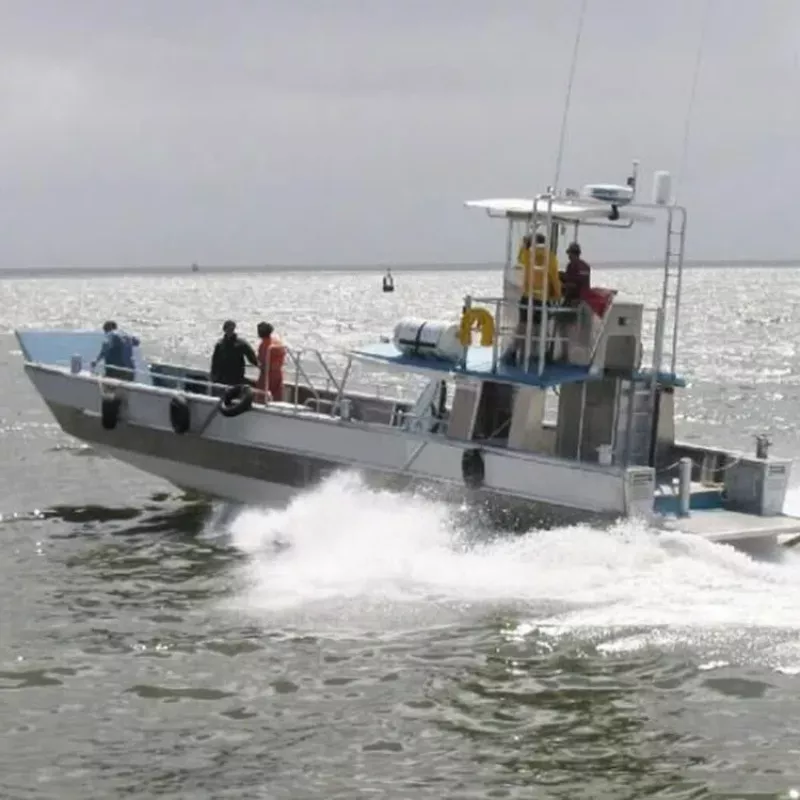
1. What Exactly Is a Work Boat and Who Uses One?
A work boat (or workboat) is a utility boat built for commercial or industrial tasks rather than leisure, and aluminum work boats are widely used because they are light, strong, and corrosion-resistant. From harbor operations, dredging, and research to firefighting, fisheries, and offshore construction, these boats keep marine industries running. Operators use them to carry cargo, tow equipment, support divers, and maintain marine infrastructure. If your job involves beach landings and roll-on cargo, see our landing craft guide.
Typical Workboat Types
Different operations call for different work boat designs. Common types include:
Landing craft – for beach landings and cargo transport.
Utility boats – multipurpose platforms for harbor or service tasks.
Skiffs – compact, easily maneuverable boats for nearshore or shallow work.
Catamaran workboats – stable platforms with large deck space for research or support work.
Landing barges – heavy-duty boats with open decks for hauling vehicles or materials.
Real Buyer Needs
Choosing the right boat starts with your operational requirements. Buyers usually focus on:
Payload capacity – the weight your boat can safely carry.
Deck layout – open, customizable space for cranes, tanks, or gear.
Crew capacity – safe operation and comfort for everyone on board.
Beaching ability – critical for shallow or tidal operations.
Stability and handling – especially in rough or variable conditions.
2. Why Choose Aluminum for Your Work Boat?
Hull material directly affects cost, performance, and long-term value. Many commercial operators choose aluminum for its balance of strength, weight, and durability, which gives a low cost of ownership over time.
Key Advantages
An aluminum work boat offers several operational benefits:
Durability: Marine-grade aluminum resists corrosion and impact, so the boat stays in service longer in tough conditions.
Light weight: Lower weight means better fuel economy, higher speed, and easier trailering or launching.
Repairability: Dents and damage can be welded or straightened locally, while composites need more complex repairs.
Low maintenance: Aluminum does not rot or need frequent repainting, which cuts upkeep and downtime.
Coastal operators who switch to aluminum often report noticeably lower fuel use and fewer maintenance hours each season.
Potential Drawbacks
Aluminum does have trade-offs. It can be noisier in choppy water and may dent under heavy impact, thermal expansion can cause minor noise in extreme heat, and bare metal is not as glossy as fiberglass. Sound-damping insulation, reinforced hull plating, and professional finishing address these issues, and all are standard practice in Poseidon’s shipyards.
3. Six Technical Specs That Decide the Right Fit
When comparing models or requesting quotes, check these technical details to find the boat that fits your mission.
Hull Design & Gauge
Hull shape affects payload, speed, and maneuverability. A deeper V-hull handles rough water better, while a flatter bottom makes beaching easier. Plate thickness should match the load: heavier work boats need thicker plate.
Payload, Deck Layout & Strength
The deck must carry equipment, tie-downs, and toolboxes without flexing. Reinforced decks and built-in lashing points improve safety in heavy work.
Engine & Propulsion Choices
Outboards offer flexibility and lower maintenance costs, while inboard or waterjet propulsion gives power and control in shallow or debris-filled water. Consider fuel economy and service access as well.
Corrosion Protection & Welding Quality
Marine-grade alloys such as 5083 and 5052 resist salt-water corrosion. Good welding ensures structural integrity, and protective coatings and sacrificial anodes prevent electrolytic damage.
Safety & Regulatory Fit
The boat must meet navigation light, stability, and local safety rules. A reliable builder designs these requirements into every boat.
Customization & Modular Deck Systems
Modern work boats often use modular equipment, such as cranes, fuel tanks, toolboxes, or water pumps, matched to the mission. A custom layout improves both productivity and crew comfort.
4. Common Applications and Example Configurations
Every operation needs a different setup, and aluminum makes customization easier. Here are common work types and the configurations that suit them. For pilot, patrol, dive, and survey boats, see our commercial boat guide.
Construction and Pile Driving
Heavy-duty hulls with wide, reinforced decks carry cranes and heavy loads, and beachable landing craft reach remote sites without a pier.
Fisheries and Aquaculture
These operators need easy-to-clean non-slip decks, built-in live wells, and gentle handling of gear and catch. Aluminum resists corrosion from salt and organic matter, so the boat lasts.
Environmental, Spill Response, and Research
Catamaran work boats give stability and deck space for monitoring or containment equipment, making them good platforms for environmental monitoring, oil spill response, and coastal research. For hydrographic and water monitoring work, see our survey boat guide.
Patrol and Emergency Services
Speed, agility, and crew protection matter most. Enclosed cabins, rescue ladders, and strong propulsion allow fast response in harsh conditions.
5. Maintenance, Lifetime Costs, and ROI
Aluminum boats generally cost less to own over their life, but they still need proper care to stay efficient and safe.
Routine Maintenance Checklist
After each use, rinse the hull with fresh water, inspect the sacrificial anodes, and check welds for corrosion or cracks. Yearly paint touch-ups and hull inspections extend service life.
Repairability and Local Support
Aluminum is simple to repair: local welders can handle most jobs without special materials, which keeps downtime lower than with composite boats.
Typical Lifecycle and Resale Value
With proper maintenance, aluminum boats stay in service for decades, and good resale value and easy refits make them a cost-effective long-term investment.
6. How to Pick the Right Aluminum Work Boat
Follow these steps when choosing a boat for your fleet or operation:
Define your mission profile – What must the boat do every day?
Set payload and deck requirements – Load limits, gear, and storage.
List essential equipment – Cranes, tanks, pumps, or cabins.
Evaluate hull design and fabrication – Check welding quality and plate thickness.
Ask for references and support options – Confirm service support and spare parts availability.
Poseidon Boat can help you compare options and choose the right aluminum work boat for your job.
7. Why Choose Poseidon Boat’s Aluminum Work Boats
Poseidon Boat builds every boat to professional standards. From three shipyards in Qingdao, Jinan, and Xinyi, we design and build 5.8–21m boats for marine transport, construction, rescue, and engineering work.
Our strengths are skilled aluminum welding, efficient hull designs, and full customization to your job. Every boat is built for reliability, efficiency, and safety, and is backed by responsive after-sales service and worldwide delivery.
8. Conclusion
The best work boat is the one that matches your mission, whether that means hauling heavy equipment, supporting marine construction, or protecting the environment. An aluminum work boat from Poseidon Boat means lower operating costs, more uptime, and dependable performance. Planning a commercial aluminum boat project? Send us your route, capacity, and operating conditions, and our engineers will recommend a configuration and quotation.


