-
System capacity over individual capacity: Route throughput depends on boat size and sailing frequency together; more frequent sailings with smaller boats often give better off-peak economics.
-
Regulations set hard limits: Commercial passenger capacity is set by stability tests, tonnage limits, and regulatory classification (for example, USCG Subchapter T or K in the United States), not by floor space alone.
-
Recreational formulas do not apply: The “length × width ÷ 15” rule is only for small recreational boats; commercial operators rely on naval architecture and official stability approval.
-
Right-sizing maximizes return: A 40-passenger ferry on a short, high-turnaround route can earn better margins with fewer crew than a half-empty 150-passenger boat.
-
Materials matter: Hull material (aluminum or steel) changes the boat’s lightship weight and therefore the deadweight left for passengers.
The Core Equation: System Capacity vs. Service Frequency
Analyzing Route Demand, Variance, and Mixed-Use Needs
Successful ferry route planning starts with baseline daily ridership, peak-hour surges, and seasonal swings. A common mistake is sizing the boat for the single busiest hour of the year, which guarantees inefficiency the rest of the time. Instead, calculate the hourly throughput you need, the system capacity: how many people you move per hour, not per boat. Capacity planning is one step in our passenger boat guide, which also covers hull type, layout, safety, and costs.
To calculate system capacity:
-
Measure the peak passenger count in the busiest morning and evening commute hours from ticketing data.
-
Identify off-peak ridership in the middle of the day to set the minimum viable load.
-
Set the maximum turnaround time at your main terminals, including mooring and gangway handling.
-
Calculate how many round trips one boat can make per hour from transit speed and terminal time.
Allow for what passengers bring with them. Commuters carry bicycles, e-scooters, and heavy luggage, all of which take passenger space. On a route with many cyclists, a boat rated for 100 passengers might carry only 70 people with their bikes. A bicycle takes roughly the deck space of two standing passengers and needs racks, tie-downs, and wider aisles, which all reduce maximum headcount.
The Trade-Off: Large Boats vs. High-Frequency Fleets
Operators can run one large boat infrequently or several smaller boats often. Compare one 150-passenger boat every hour with three 50-passenger boats every 20 minutes: the large boat needs a much bigger investment and crew, and still burns significant fuel when running at 20% capacity in the midday lull.
High-frequency fleets have clear advantages. Passengers hate waiting, and a 20-minute interval competes strongly with road transport, since a commuter who misses a boat knows another is coming soon. You can also scale service up and down and take a boat out for maintenance off-peak without closing the route.
Frequent service also makes crew shifts more efficient: run one or two boats all day on standard shifts and add the third only for the morning and evening peaks, instead of paying a full crew to sit on a large, empty boat at noon. It adds redundancy too, because a breakdown on one small boat only reduces throughput, while a breakdown on a single large boat stops the route.
Regulatory Frameworks and Compliance Constraints
Stability, Tonnage, and Legal Passenger Limits
Maritime authorities such as the USCG, MCA, and AMSA set maximum passenger ferry capacity on intact and damage stability criteria. Naval architects carry out inclining experiments, moving weights across the deck to simulate passengers crowding to one side, and the results set your legal limit.
The assumed weight per passenger matters a great deal. US rules once assumed about 73 kg (160 lb) per passenger and now use 84 kg (185 lb) or more, so a boat certified for 150 passengers ten years ago might qualify for only 120 under current rules. Always check the assumed passenger weight when evaluating a new build or a used boat.
Crewing Requirements and Operating Tiers
Operating costs do not rise smoothly; they jump at regulatory thresholds. In the United States, for example, going from 149 to 150 passengers moves a boat from Subchapter T to Subchapter K.
That step brings stricter fire safety systems, heavier structural requirements, and a larger mandatory crew, possibly including licensed engineers. Map these tiers before fixing the boat size: ten extra seats can look like extra peak revenue, but if they require another licensed crew member and a sprinkler system, margins disappear. Always check whether staying just below a threshold saves significant capital.
Operational Enforcement and Dynamic Restrictions
Your certificate of inspection or passenger certificate is not a guideline. Maritime and port authorities enforce passenger limits with spot checks, and breaches bring heavy fines, suspended licenses, and boats taken out of service, so strict ticketing and boarding controls are essential.
Plan for temporary limits as well. A certificate may allow 100 passengers in calm water, but bad weather, high seas, or route hazards can bring temporary restrictions, and the master can always limit numbers further for safety. Your financial model should include these lost-revenue days.
Technical Evaluation: How Boat Design Dictates Capacity
Hull Type (Catamaran vs. Monohull) and Deck Layout
Hull form sets the basic limit on how many people you can carry. Catamarans have a clear advantage for passenger transport: twin hulls give a much wider beam than a monohull of the same length, allowing more passengers per meter of length, and their high initial stability helps them pass crowding tests.
Deck layout turns theoretical capacity into real capacity. Seats cannot be packed edge to edge: accessibility rules require wide aisles and wheelchair turning space, escape routes must stay clear, and every life jacket locker, fire station, and briefing area takes floor space. A poor layout can cut legal capacity by 15% or more, so place safety equipment before finalizing seating.
Construction Materials and Weight Dynamics
Construction material directly affects revenue, because every kilogram of structure is a kilogram you cannot use for passengers. Heavy steel hulls are very durable for ice-class work, but they take up a large share of displacement and leave less deadweight for passengers, crew, and fuel.
Marine-grade aluminum is the better choice for most commuter routes. It greatly reduces lightship weight, leaving more deadweight for passengers than a steel hull of the same size. Composites also save weight, with different maintenance needs. Consider long-term care too: aluminum needs careful isolation against galvanic corrosion, while steel needs constant coating maintenance against rust.
Payload Dynamics and Route Distance
Route length changes what a comfortable trip means. A five-minute harbor crossing needs only basic benches and standing room, since passengers accept high density for short trips, but longer routes need more amenities to keep passengers satisfied.
Trips over 30 minutes need proper toilets, a kiosk, and larger, more comfortable seats, all of which take passenger space. A boat that holds 100 people on a short crossing might hold only 65 when fitted out for a two-hour coastal route, so define the service level before calculating final capacity.
Sizing the Fleet: Commercial Passenger Boat Categories
Micro-Ferries and Water Taxis (Up to 49 Passengers)
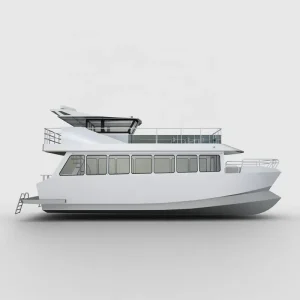
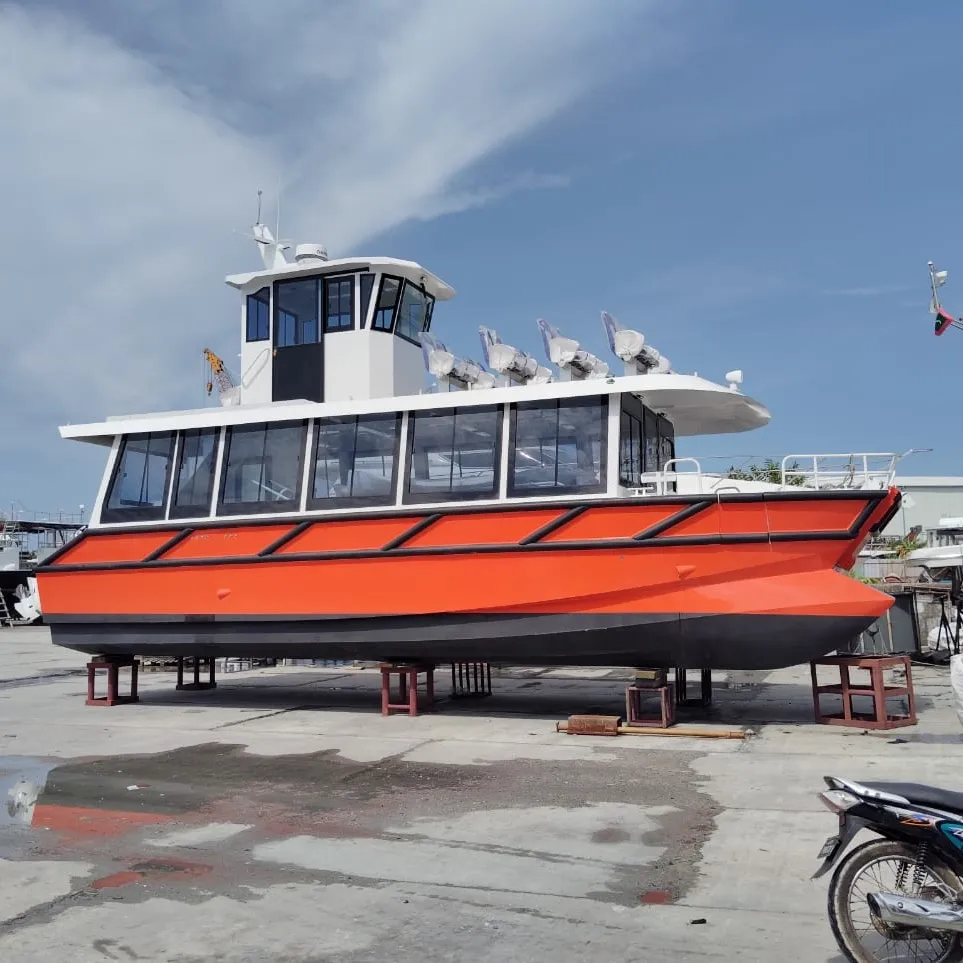
Small ferries are the ideal way to start new operations. A 40 passenger ferry boat, such as our 11.6m aluminum catamaran passenger boat, suits short harbor crossings and testing new routes, with low capital cost and limited regulatory overhead.
In many jurisdictions, staying below about 50 passengers keeps the boat under lighter small-passenger-boat rules, with lower crewing levels and simpler maintenance. Small ferries excel on high-frequency loop routes where fast boarding keeps the schedule, and they often use existing municipal floating docks without modification.
Mid-Size Commuter Ferries (50–149 Passengers)
Mid-size boats are the sweet spot for established routes, balancing moderate investment with good peak-hour throughput. In the United States, a well-designed 149-passenger boat maximizes revenue while staying just below the stricter rules that start at 150 passengers.
They handle moderate seas better than water taxis and have room for bicycles and basic amenities without losing too many seats. Many operators use mid-size ferries as the backbone of the fleet, running them on main commuter lines at rush hour and reducing frequency in the midday lull.
High-Capacity and Ro-Pax Boats (150+ Passengers)
High-capacity ferries serve mass transit corridors and need major infrastructure and investment. Above 150 passengers, regulation becomes much stricter, and many of these ferries also carry vehicles (ro-pax), which changes loading and stability requirements completely.
They need deep-water terminals and purpose-built docking; a 300-passenger ro-pax ferry cannot tie up at a small wooden pier, and the shore investment can exceed the cost of the ferry. They only pay off on routes with guaranteed high daily ridership, and vehicle loading lengthens terminal time and reduces daily round trips.
Fleet Standardization and Boat Classes
Mixing boat sizes and engine types creates a logistical headache. Large public ferry systems standardize their fleets into a few boat classes to control costs, and operators should aim for two or three standard capacity tiers.
Standardization greatly simplifies crew training, since a captain qualified on one 149-passenger catamaran can step onto any sister boat. It also simplifies spare parts, with one type of oil filter, alternator, and water pump in stock, and when a boat needs unexpected maintenance, a sister boat can take over without disrupting the schedule.
|
Boat Category |
Passenger Range |
Primary Use Case |
Regulatory Impact |
|---|---|---|---|
|
Micro-Ferries & Water Taxis |
Up to 49 |
Short harbor crossings, new route testing, high-frequency loops. |
Low overhead. Lighter regulatory requirements. Minimal crewing. |
|
Mid-Size Commuter Ferries |
50–149 |
Established municipal routes, peak-hour commuter transit. |
Moderate overhead. Maximizes throughput below the stricter 150+ passenger rules. |
|
High-Capacity & Ro-Pax |
150+ |
Mass transit corridors, vehicle transport, long-distance coastal routes. |
High overhead. Requires strict Subchapter K (or equivalent) compliance and deep-water terminals. |
Financial Implications: CAPEX, OPEX, and Capital Investments
Fuel Consumption and Capacity Utilization Rates
Model the cost per passenger-mile carefully. Fuel is the largest variable cost in any marine operation, and running a large boat at 20% capacity off-peak sends the fuel cost per passenger soaring; you are burning fuel to move empty seats across the bay.
Right-sized boats running at 80% capacity are very fuel-efficient per passenger. Study the engine builder’s fuel curves and compare smaller engines at their best rpm with large engines running at low, inefficient loads. Matching passenger boat capacity to actual demand stops you losing money in the midday slump. Consider hull fouling too, since the larger wetted surface of an oversized boat adds drag over time.
Infrastructure and Terminal Constraints
Boat size is capped by the terminals. Existing docks set the maximum length and beam: if your pier takes an 18m (60ft) boat, a 24m (80ft) catamaran will not fit, whatever the demand. Draft limits matter too, since shallow harbors need low-draft boats, which limits displacement and payload.
Wake rules are another hidden constraint. Many inland waterways and busy harbors limit wake size, and large, heavy boats make bigger wakes, so you may have to run smaller, lighter boats or run large boats very slowly, which hurts schedule reliability. Survey the route for depth and wake limits before choosing hull size.
Implementation Risks in Ferry Route Planning
Over-Capitalization on Unproven Routes
Never buy maximum-capacity boats before demand is proven; it is the fastest way to sink a new ferry operation. Municipalities and private operators often overestimate early ridership from optimistic surveys, and launching a large commercial passenger boat on day one locks you into high capital payments and daily operating costs.
Reduce the risk by chartering smaller boats for the first year to validate ridership, test schedules, and measure seasonal dips before committing to a large build. Phased fleet growth lowers financial exposure and makes sure your permanent boats match real demand, and smaller boats can be sold or redeployed once the route needs larger ones.
Future-Proofing and Scalability
Adding capacity later is difficult. You cannot simply bolt more seats onto a deck: extra passengers change the center of gravity and need new stability tests and approvals, and the structure often cannot support it.
Instead of stretching a small boat, plan to scale by frequency. Design terminals for fast turnarounds, and when demand outgrows the current boat, add another boat to the schedule rather than attempting a costly conversion. This keeps fleet classes standard and avoids taking a main boat out of service for months.
-
Carry out a route feasibility study to map peak and off-peak demand and bicycle and luggage needs.
-
Audit your terminals to set the maximum boat length, beam, draft, and wake limits.
-
Ask a naval architect for preliminary stability assessments using current assumed passenger weights.
-
Ask builders for life-cycle cost models comparing the fuel burn of different capacity tiers at 50% and 80% occupancy.
FAQ
Q: How is commercial passenger boat capacity legally calculated?
A: It is based on intact and damage stability tests, usable deck space, and formulas set by maritime authorities such as the USCG. Commercial operators cannot use recreational length-by-width formulas; naval architects run inclining experiments to establish the safe legal limit.
Q: What is the ideal passenger ferry capacity for a new commuter route?
A: Start with smaller boats, typically 40–50 passengers, to test real demand, validate schedules, and build ridership while keeping capital and daily operating costs as low as possible.
Q: How does a 40 passenger ferry boat differ in regulations from larger boats?
A: Boats below certain passenger thresholds come under lighter regulatory categories, with lower crewing levels, simpler fire safety requirements, and lower construction and maintenance costs than boats carrying 150 or more passengers.
Q: Can you increase the passenger capacity of an existing ferry?
A: It is very difficult and costly. It needs new stability tests, possibly major structural changes, and updated regulatory approval, and often the original hull simply cannot carry the extra weight safely.
Q: How does ferry route planning impact boat selection?
A: Route planning drives everything. Route length decides the amenities, which take seating space; expected wave heights decide the hull type; and terminals limit the draft and beam you can use.
Related reading
- What Capacity Passenger Ferry Boat Do You Need for Your Route?: estimate demand and match boat size to your route
- 50–105 Seat Passenger Ferry Boat Buying Guide for Operators: specs, compliance, and procurement for larger ferries
- Small Passenger Ferry Boat vs Large Passenger Ferry Boat: How to Choose: agility and low overhead versus scale
Planning a passenger ferry project? Send us your route, capacity, and operating conditions, and our engineers will recommend a configuration and quotation.