
Key Takeaways
-
Passenger boat capacity is the starting point, but the real decision depends on draft limits, off-peak utilization, and regulatory thresholds.
-
Small passenger boats turn around faster and need fewer crew, which suits frequent, short, or environmentally sensitive routes.
-
Large ferries offer economies of scale and better weather resilience but need heavy upfront investment and deep-water infrastructure.
-
Regulatory requirements (for example, USCG Subchapter T or K in the United States, or European equivalents) rise sharply with tonnage and capacity, changing operating costs fundamentally.
Defining the Baseline: What Separates Small from Large?
Objective Thresholds
A sound fleet decision starts with clear classifications. The usual measures are length overall (LOA), gross tonnage (GT), and total passenger boat capacity. These numbers determine more than physical size; they decide which regulations apply. Size is only one of the choices covered in our passenger boat guide for operators.
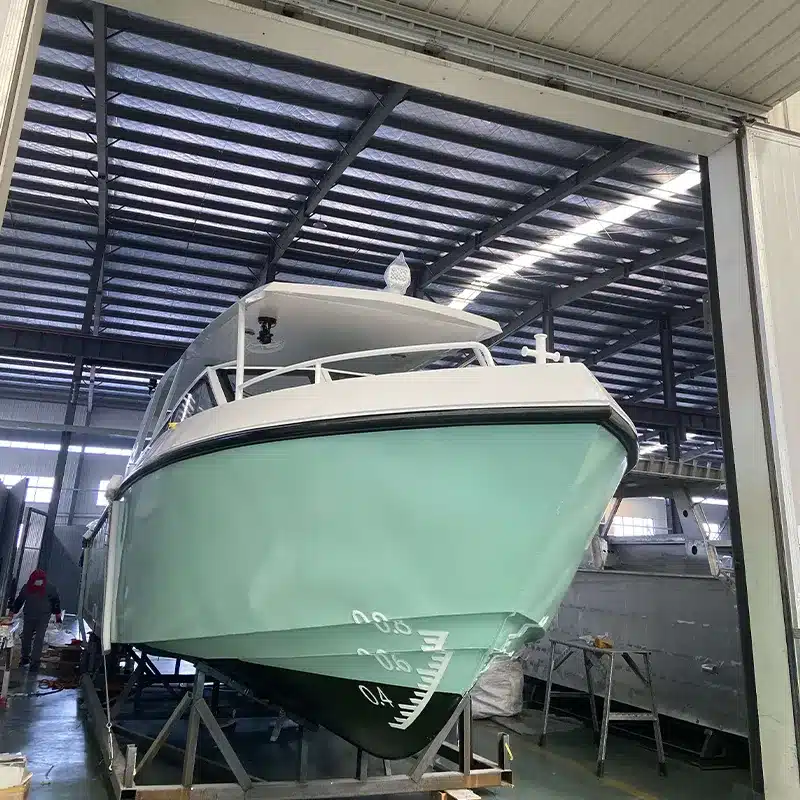
A small passenger boat is typically under 100 GT and carries 150 passengers or fewer. These boats work in coastal areas, rivers, and protected harbors, where their shallower draft and compact size give good maneuverability.
By contrast, a large passenger ferry exceeds 100 GT and carries from 150 to over 1,000 passengers. Many have roll-on/roll-off (ro-ro) vehicle decks and multi-deck amenities, and this complexity puts them in higher compliance categories.
The Commercial Use Case
Boat size follows the business model. Smaller ferries excel at fast point-to-point service on commuter routes that need frequent departures and quick turnarounds. Larger ferries move high volumes of commuters or tourists, often with vehicles and cargo, over longer and more exposed crossings.
Route Dynamics and Infrastructure Constraints
Draft and Docking Limitations
Geography narrows your options before you look at any brochure. A large ferry is limited by port infrastructure: deeper hulls need dredged channels, and many older or regional piers cannot withstand the berthing forces of a large boat.
Common Mistake: Buying deep-draft boats without long-term dredging agreements. A silted harbor can ground an expensive boat at low tide.
Environmental and Wake Restrictions
Environmental sensitivity is now central to route planning. Many coastal reserves and protected archipelagos limit boat size and monitor wake closely, because large displacement hulls create wakes that erode shorelines and disturb marine habitats. In these areas operators effectively need smaller, lower-impact boats, and catamarans help by reducing drag and wake.
Weather and Sea State Resilience
Agility has to be weighed against weather resilience. Smaller boats are more affected by rough seas, and high winds can force cancellations that frustrate commuters and damage reliability. Larger ferries, with their weight and stabilization systems, handle heavy seas better and suffer far fewer weather delays on open-water routes.
Operational Costs (OpEx) and Revenue Scaling
Fuel Consumption vs. Yield per Passenger
Fuel economics are complex. Large ferries burn more fuel in total and need big engines to reach service speed, but their cost per passenger is very low when they run nearly full. Smaller boats burn less fuel per trip, yet their limited capacity often means a higher cost per ticketed passenger.
The Off-Peak Profitability Trap
Financial risk peaks in the low season and off-peak hours. Running a 500-passenger ferry for 30 commuters destroys margins, the classic off-peak trap. Smaller ferries give flexibility: increase frequency at rush hour and reduce it midday without wasting fuel and labor.
Crewing Ratios and Labor Costs
Maritime rules set crew-to-passenger ratios that rise sharply with boat size and route category. A commercial ferry boat carrying fewer than 150 passengers may legally operate with a master and one or two deckhands. Above 150 passengers, labor needs jump, with engineers, extra deck officers, and dedicated passenger safety staff, all of which raise daily operating costs.
Passenger Experience and Service Offerings
Transit Time vs. Amenities
Each class offers a different value. Smaller ferries usually board and unload much faster, with fewer bottlenecks at the gangway, and may be faster under way, especially with fast catamaran hulls.
Larger ferries trade speed for amenities and stability, with shops, full food and beverage service, and premium lounges that bring significant secondary revenue.
Target Demographic Match
Matching boat size to your passengers avoids a mismatch. Commuters value speed, frequency, and quick disembarking, which smaller, faster boats deliver. Tourists value views, comfort, and avoiding seasickness, which a large, stable ferry with a cafe and observation decks provides.
Regulatory Compliance and Certification Risks
Survey and Certification Shifts
Compliance gets much more complex when moving from small to large categories. In the United States, moving from Subchapter T (small passenger boats) to Subchapter K changes the engineering requirements fundamentally, with advanced fire suppression, more extensive life-saving equipment, and structural fire protection zones throughout the boat. These upgrades are very expensive.
Best Practice: Ask a naval architect to map regulatory trigger points before you finalize a purchase.
Insurance Premiums and Liability
Insurance follows risk. Hull and machinery cover scales with replacement value, and protection and indemnity (P&I) cover scales with passenger capacity and route risk. Insuring a ferry with 800 people on open water costs very differently from insuring a 50-passenger river taxi, so build these premiums into your financial model.
Emission Mandates
Environmental standards tighten every year. IMO Tier III emission rules target large marine diesel engines and usually need selective catalytic reduction (SCR) systems that take valuable engine room space, and zero-emission rules in some regions push operators toward hybrid or fully electric propulsion. Electrifying a large ro-ro ferry is a far bigger engineering challenge than electrifying a light harbor taxi.
Decision Framework: Shortlisting Your Fleet Strategy
Boat Strategy Comparison Summary
|
Decision Criteria |
Small Passenger Ferry |
Large Passenger Ferry |
|---|---|---|
|
Initial CapEx |
Relatively low; easier financing. |
High; requires major capital backing. |
|
Draft Requirement |
Shallow; versatile docking. |
Deep; restricted to major ports. |
|
Crewing Levels |
Minimal; lower daily OpEx. |
Extensive; strictly regulated ratios. |
|
Best Route Profile |
High-frequency, short-distance runs. |
High-volume, long-distance, or open water. |
When to Choose a Small Passenger Ferry
-
Your route requires exceptionally high departure frequency to remain competitive against alternative transit methods.
-
You face shallow draft conditions or strict infrastructure limits at your destination ports.
-
Demand is highly seasonal or unpredictable, so you need tight control of daily operating costs to get through the low season.
-
You operate inside environmentally sensitive zones enforcing strict wake and emission caps.
When to Choose a Large Passenger Ferry
-
You operate a guaranteed high-volume route, such as major mainland-to-island commuter lines.
-
You want to combine passenger transport with vehicle or cargo revenue (ro-ro).
-
Your route crosses open water requiring high sea-state stability to prevent passenger seasickness.
-
You intend to capture high secondary revenue streams via onboard retail and dining.
Next Steps
Do not decide on purchase price alone. Commission a route feasibility study and ask a naval architect to model your route, including wave heights, wind patterns, docking limits, and passenger flow, before you start procurement.
Conclusion
Choosing between these two categories is rarely about which boat is better; it is about matching the boat to your route economics. A large ferry fails quickly on a low-volume, shallow route, while a small water taxi cannot cope with heavy commuter surges.
Evaluate your infrastructure carefully, analyze peak and off-peak demand, and understand your regulatory environment. Aligning these factors gives you a fleet strategy that supports long-term profitability and smooth daily operations.
FAQ
Q: What is the standard passenger boat capacity for a commercial small ferry?
A: Small commercial ferries are usually limited to 149 passengers, because many jurisdictions, including the United States under USCG Subchapter T, use 150 passengers as a regulatory cut-off. Above it, structural, fire safety, and crewing rules become much stricter.
Q: Do large passenger ferries have a better ROI than small passenger boats?
A: It depends on utilization. A large ferry running full offers excellent economies of scale, but a full small boat is far more profitable than a large one running at 20% capacity off-peak.
Q: How do maritime regulations change based on ferry boat size?
A: Requirements rise sharply. Larger boats need structural fire protection, more complex fire suppression, and more extensive life-saving equipment, as well as stricter crew ratios with more deck officers and engineers.
Q: Can a small passenger boat handle open ocean routes?
A: Usually not. Small, light hulls have limited sea-state capability and can be uncomfortable and unsafe in rough weather, so authorities typically restrict them to protected waters, rivers, or defined coastal routes.
Planning a passenger ferry project? Send us your route, capacity, and operating conditions, and our engineers will recommend a configuration and quotation.


